
The 5 Stages of Startup Growth No One Talks About by Shreesha Ramdas
LumberFi CEO Shreesha Ramdas breaks down the 5 startup fitness stages, contrarian hiring moves, and the AI shift quietly reshaping every business.

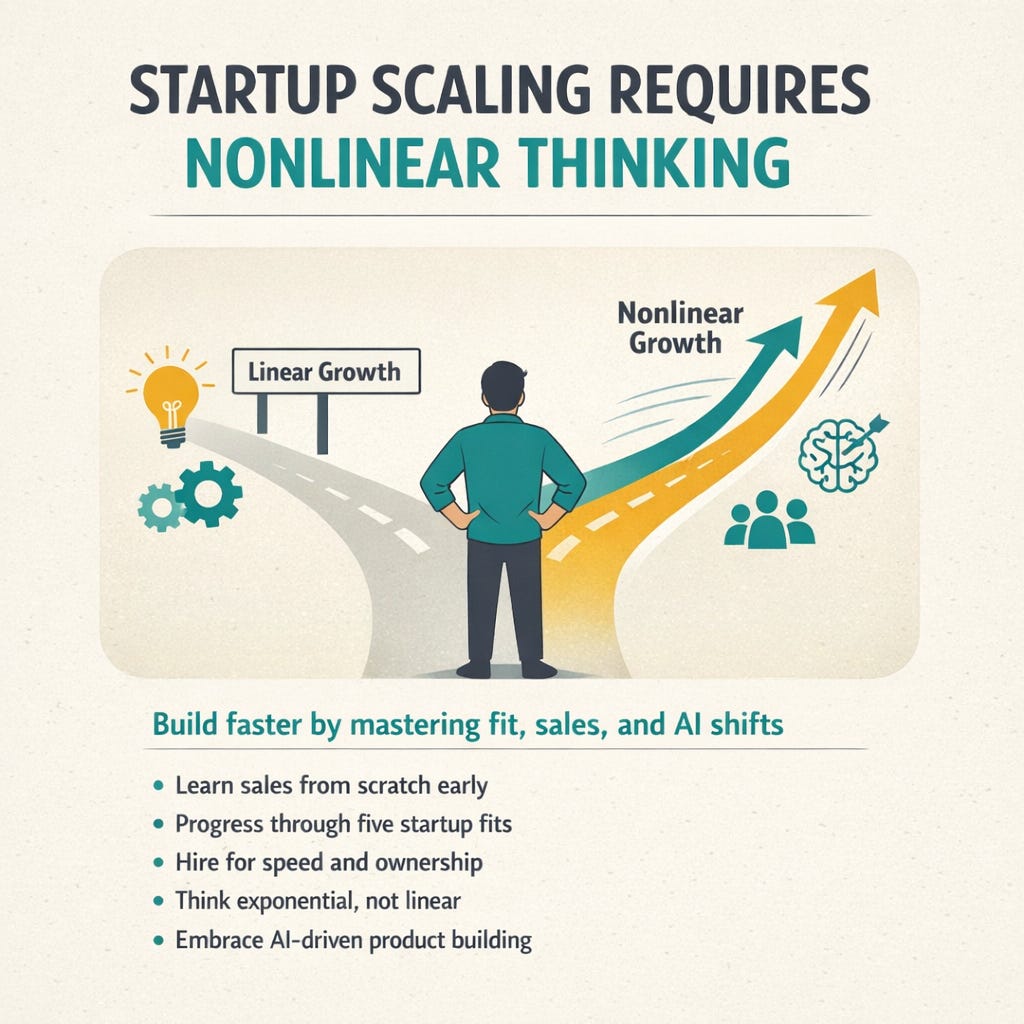
Most business conversations about growth circle around the same question: do you have product-market fit yet? It’s become the benchmark everyone chases, the milestone that supposedly separates the companies that make it from the ones that don’t.
But Shreesha Ramdas thinks that framing leaves out four other stages that matter just as much and that most founders are so focused on stage three that they never properly solve stages one, two, four, or five.
Shreesha is the CEO and co-founder of LumberFi, a workforce management and payroll platform built specifically for the construction industry. He’s a serial founder who has built and sold companies before, spent time inside Medallia as it went public, and is now three years into what he describes as the most meaningful work of his career. He came from a technology and engineering background with zero construction experience and has spent the years since going deep into one of the most underserved, complexity-ridden industries in the world.
In a conversation on the Founder’s Lens podcast with host Mayur Mistry, Shreesha covered more ground in an hour than most founder content covers in a series. What follows is an attempt to do justice to that the frameworks, the specific decisions, the honest admissions, and the observations about where business is heading that deserve more attention than they’re getting.
The Five Stages Every Business Has to Pass Through (Product-Market Fit Is Only Stage Three)
Shreesha calls this the “fitness journey” and it maps the full arc of building a startup from idea to scale. Most founders treat the journey as: build something, find customers, grow. His version is more precise, and more demanding.
Stage one: Problem fit. Before anything gets built, two questions need honest answers. How significant is this problem, really? And do you actually have the capability to solve it? Not the capability you wish you had, or the capability you’re going to hire for eventually the capability that exists right now. Problem fit is about clarity over enthusiasm. A lot of companies get started because a founder finds an idea exciting rather than because they’ve genuinely confirmed the problem is large enough and solvable by them. That mismatch haunts everything that comes after.
Stage two: Market fit. Is the total addressable market big enough to build a real business? This is separate from whether the problem is real. You can identify a genuine problem that genuinely needs solving and still be building in a space too small to generate sustainable growth. Market fit asks the ceiling question before you’ve invested years into building.
Stage three: Product-market fit. This is the stage everyone already knows and debates. Does the product resonate with the customers it was built for? Are people using it, staying, and getting what they came for? This is where most founder conversations begin and end, which is precisely the problem.
Stage four: Go-to-market fit. Here is where things get interesting, and where Shreesha’s perspective departs from the standard playbook. He argues that even after you’ve built a product customers love, you can still fail at go-to-market fit. The question at this stage is whether you’re positioning and messaging the product in a way that customers actually understand and value it. A great product explained badly still loses to a mediocre product explained well. This is the invisible ceiling for a huge number of companies that plateau at a certain revenue level and can’t understand why their growth has stalled, they’ve solved product-market fit but never solved go-to-market fit.
Stage five: Scale fit. The one almost nobody talks about. Scale fit is the question of whether you can grow without proportionally increasing friction. Shreesha describes the test simply: if pushing more product out into the market feels like you’re applying enormous pressure just to move the needle, if every new customer feels like an uphill battle, you haven’t achieved scale fit. And if you can’t get there after genuinely trying, the honest next question is about exit.
What makes this framework practical is that it doubles as a diagnostic. If your sales team is struggling, you might assume it’s a messaging problem, but it could be an unresolved problem fit issue from year one. If you have strong early customers but anemic growth, it might not be a sales problem, it might be a market fit problem you never fully interrogated. Each stage has its own failure mode, and you can’t fully solve a later stage while an earlier one is still broken.
The Most Unconventional Hire in Lumber’s History (Made on Day Zero)
When Shreesha started LumberFi, the first hire was a sales leader. Not an engineer. Not a technical co-founder. A sales leader hired before a single line of code had been written, before any product existed, before they had even brought an engineer on board.
The reasoning is worth understanding fully, because it cuts against almost everything you’re told about early-stage company building.
The default path for most founders is to build an early customer base through personal networks. You reach out to people you know, people who already respect you, people who take your call because of the relationship. They give you feedback. The product gets refined based on that feedback. The problem, Shreesha points out, is that this feedback is filtered. People who already have a connection with you will soften the hard truths. They’ll be encouraging when they should be critical. And so your product ends up shaped around a version of market reality that’s been smoothed and biased by personal goodwill.
By hiring a sales leader on day zero and sending him into the market before anything was built, Lumber got something rare and genuinely valuable: unfiltered feedback from strangers. From people with no relationship with the team and no reason to be kind. Real reactions to a real problem statement, before the product had a chance to get built in the wrong direction.
The sales leader they hired had a background as a carpenter, which meant he could speak the language of the construction industry and actually be taken seriously in the rooms he was entering. He attended construction forums, had real conversations with operators, and brought back raw market intelligence that shaped everything that came after.
This is a practical version of what Paul Graham, founder of Y Combinator and one of the most influential voices in startup thinking, meant when he wrote about doing things that don’t scale. The idea is that in the early stages of a company, efficiency isn’t the point. Learning is. Sending a sales leader into the field to generate market feedback before your product exists is deeply inefficient and deeply effective. You’re not trying to build a machine yet. You’re trying to figure out what the machine should do.
The outcome: LumberFi launched a payroll product, one of the most technically complex categories in software, with an enormous number of rules, variations, and compliance requirements within six months of founding. And they reached serious customer scale in under three years.
What Happened When an Engineer Forced Himself to Learn Sales From Scratch
Shreesha is honest about something most technical founders avoid admitting. Early in his career, he resented the sales team.
He was an engineering leader. The sales team would come in with customer requirements that didn’t fit the roadmap, push for customizations that complicated the architecture, and generally create more work for the people who were actually building things. This is not a unique experience. It plays out inside technology companies constantly, and it creates a cultural divide that slows companies down in ways that are hard to measure.
What changed wasn’t a philosophy shift. It was a deliberate, uncomfortable decision to go learn sales himself. Not conceptually. Not by hiring someone and watching. By doing it starting with cold calls, which by his own description were mortifying for someone who’d spent years as an engineer.
He remembers his first cold call. He was hoping it would go to voicemail.
From that starting point, Shreesha describes what he calls the functional evolution of a founder. The engineering mindset gives way, slowly and sometimes painfully, to an understanding of sales. Then to go-to-market and brand building, which he notes doesn’t come naturally to people with technical backgrounds because engineers solve defined problems, while brand building is about painting a vision that doesn’t yet exist and making people feel something about it. Then to finance, where the education isn’t just about raising capital but about deploying it well: understanding the difference between organic and inorganic growth, knowing when an acquisition makes more sense than building, and modeling the compounding effects of both.
For business owners who’ve built real expertise in one domain, this is the uncomfortable truth embedded in Shreesha’s story. The skills that got you to your current level of success are not automatically the skills that take you to the next one. The question is whether you’re willing to be a beginner again at the things that make you uncomfortable.
The Culture Code That Keeps a High-Agency Team Pointed in the Same Direction
Here’s a question worth sitting with: if you brought together a team of people who’ve been founders themselves, who have strong opinions and high agency and aren’t used to being told what to do, how do you keep them aligned without everything devolving into competing priorities and quiet politics?
Shreesha’s answer at Lumber comes down to codification. Not inspiration. Not a values poster in the office. An actual shorthand that everyone internalizes and can reference in any situation.
At Lumber, the code is EOE.
E is for energy, bringing optimism, proactiveness, and momentum to every day and every problem. O is for ownership, treating every challenge as yours to solve, not someone else’s to escalate. And the second E is for experimentation, being genuinely bold about running tests, and then letting what the data shows guide the next move rather than defending the hypothesis.
When you ask why this framing works, part of the answer is in the hiring. Shreesha describes three talent pools that have been particularly effective for LumberFi. First, graduates from rigorous academic environments where hard problem-solving is the daily norm. Second, people with backgrounds in venture capital or analytical roles, where structured thinking is a survival skill. Third and this is the one he talks about with the most energy people who have been founders themselves, even if their ventures didn’t succeed.
This last group is worth unpacking. There’s a bias in business culture against founders whose companies didn’t make it. The assumption is that failure indicates something about their judgment or execution. Shreesha doesn’t see it that way. Founders who’ve been through the experience understand urgency at a cellular level. They know what it feels like to have no slack in the system, to have to find a way when there isn’t an obvious one. That understanding of real stakes and real pressure is something you can’t fully simulate by working in a well-resourced organization.
He also makes a point about team alignment that’s worth taking seriously as a leader. If you’re spending a lot of energy managing your team into alignment, that’s a diagnostic signal, not just a management challenge. It means the hiring wasn’t right, or the culture isn’t clear enough. In a well-hired, well-cultured team, alignment happens largely on its own, because everyone is operating from the same framework of values and decision-making principles. The more you have to manufacture alignment, the more the foundation needs attention.
The Acquisition Playbook: How to Grow When Building Everything Yourself Stops Making Sense
Shreesha is increasingly focused on what he calls inorganic growth, growing through acquisitions rather than purely through sales expansion and product development. His interest was sparked partly by watching General Catalyst’s work in healthcare, where they acquired a hospital, rebuilt the operational infrastructure, and then began rolling up additional hospitals on top of that base. The same pattern is starting to show up in construction, where a founder named KP Reddy recently announced a similar rollup strategy for owner’s representative firms.
The logic behind acquisitions in fragmented industries is specific and repeatable. In construction, Shreesha has noticed a pattern that plays out again and again. Someone from inside the industry identifies a real problem, builds software to solve it because they know the pain firsthand and their industry peers trust them and gets traction. Then growth stalls. They don’t have the engineering depth to evolve the product fast enough. They don’t have the marketing infrastructure to expand beyond their existing network. Revenue plateaus, and the company stays there year after year.
These companies are acquisition candidates. Not because they failed, but because they solved a hard problem and got stuck before they could scale the solution. An acquirer who brings modern technology capabilities AI infrastructure, rapid product iteration, go-to-market sophistication can unlock nonlinear growth on top of a foundation that took years to build. Neither party could get there alone.
The capital question is real and Shreesha doesn’t gloss over it. Acquisitions require money, and that usually means raising it. But the pitch to investors changes when you can show acquired revenue and model how your technology applied on top of it creates compounding returns. You’re no longer selling a growth story; you’re selling a multiplication story. And that’s a fundamentally different and more compelling conversation.
For business owners in any industry, this reframes the growth question in an interesting way. Instead of asking only how to grow your existing business faster, it opens up another question: who else in your space has built something that stalls at a certain point, and what would it look like to bring their customer base and domain knowledge inside your organization?
What AI Is Actually Doing to Your Team Right Now
Predictions about AI and the future of work range from breathless to dismissive. Shreesha’s observations are grounded in something more concrete: what he’s watching happen inside his own company, with his own team, in real time.
He makes a specific point about the pace of change that’s worth noting carefully. Six months before this conversation, he was asking LumberFi’s strongest engineers what they thought of code produced by AI models. The consensus: technically functional but inelegant. Not how a good engineer would write it. By the time of the interview, those same engineers were telling him the models are now producing code as good as what they’d write themselves. Shreesha had expected this shift to take another year, maybe two. It happened in months.
The implication he draws from this isn’t panic it’s a structural prediction about roles. He believes the separation between product management, product engineering, and product design is going to collapse. These have historically been three distinct disciplines with different career paths, different teams, and different skill sets. His view is that the people who thrive in what’s coming will be individuals who can own all three the vision, the execution, and the design. And be accountable directly for the outcomes their products create for customers. He calls these people product builders.
This isn’t a distant forecast. He’s already having this conversation with every relevant person at Lumber not as a warning, but as an opening. The tools now exist that allow one skilled person to do what previously required a cross-functional team. The question is who takes that seriously and moves into the expanded role, and who waits for the change to be forced on them.
The other prediction that deserves serious attention is about companies in what he calls “no man’s land.” Companies that were founded seven or eight years ago built their technology on the best practices of that era. Today those approaches are dated, and rebuilding is expensive and slow. But these companies also haven’t been operating long enough to build the kind of customer density and revenue scale that makes them attractive acquisition targets on those terms. Newer, AI-native companies will outpace them on product. Older companies with deep customer relationships will get acquired for their distribution. The companies in the middle are in genuine trouble not because of anything they did wrong, but because of where they sit in time.
The Real Answer to Building Nonlinear Thinking
One of the threads that runs through everything Shreesha talks about is the gap between how most people think about growth linearly, one step at a time and how he’s learned to think about it. Network effects, compounding returns, inorganic growth, exponential curves. These aren’t things most operators develop naturally, because our brains are wired for sequences, not multiplication.
He’s direct about how to close that gap, and it’s not the answer most people give. Reading about these concepts helps, but it doesn’t get you there. What actually works, in his experience, is finding people who have built something that compounded and spending real time with them not just to hear the story, but to ask the questions that let you feel what it was like when the flywheel started turning. That kind of understanding, the kind you can act on, requires human conversation. You have to let people teach you, not just let the internet inform you.
For Lumber’s own growth strategy, he’s actively looking for the levers that create this kind of compounding. Not campaign by campaign, not door by door, but structural moves that bring multiple customers or capabilities into the ecosystem at once. His advice for any founder in a fragmented industry is the same: stop thinking about marketing as a collection of channels, and start asking what network effects exist in your space that you haven’t yet found a way to tap.
One Last Thing
Somewhere in the rapid-fire section at the end of the interview, Shreesha mentions that when he was young, he wanted to be a cartoonist. His family told him he could either be an engineer or a doctor. He chose engineering, and somewhere along the way those early roads led to startups, acquisitions, and eventually to building a workforce platform for an industry that’s been underserved by technology for a very long time.
He still does caricature when he gets the time.
Someone who knows him described Shreesha as “a human LinkedIn” meaning he takes genuine joy in connecting people, in understanding who needs to know whom. That’s probably part of why the network-effect thinking comes naturally. He already lives it socially.
His final words in the interview are worth closing on: startup is an incredibly hard journey, and it requires patience and courage that most people underestimate. But persistence, he says, guarantees some form of success. Not a specific outcome. Not a billion-dollar exit. But success in the sense of having built something real and lasting is available to anyone who stays in it long enough and keeps learning.
That’s not an easy promise to make. But coming from someone who started by hoping his first cold call would go to voicemail, it’s a credible one.
If you are exploring ai in construction or need support in GTM for your construction tech startup, book a discovery call using this link :
https://calendly.com/mayur-mistry7/consultancy-discovery-call
If this journey speaks to you, you’ll get even more from the complete episode.
🎧 Listen here for more episodes: