
AI Veteran Shares What Actually Works in Business Tech by Adi Shavit
Adi Shavit built AI systems for 25 years before most knew what AI was. Here are his lessons on solving real problems and scaling smarter.

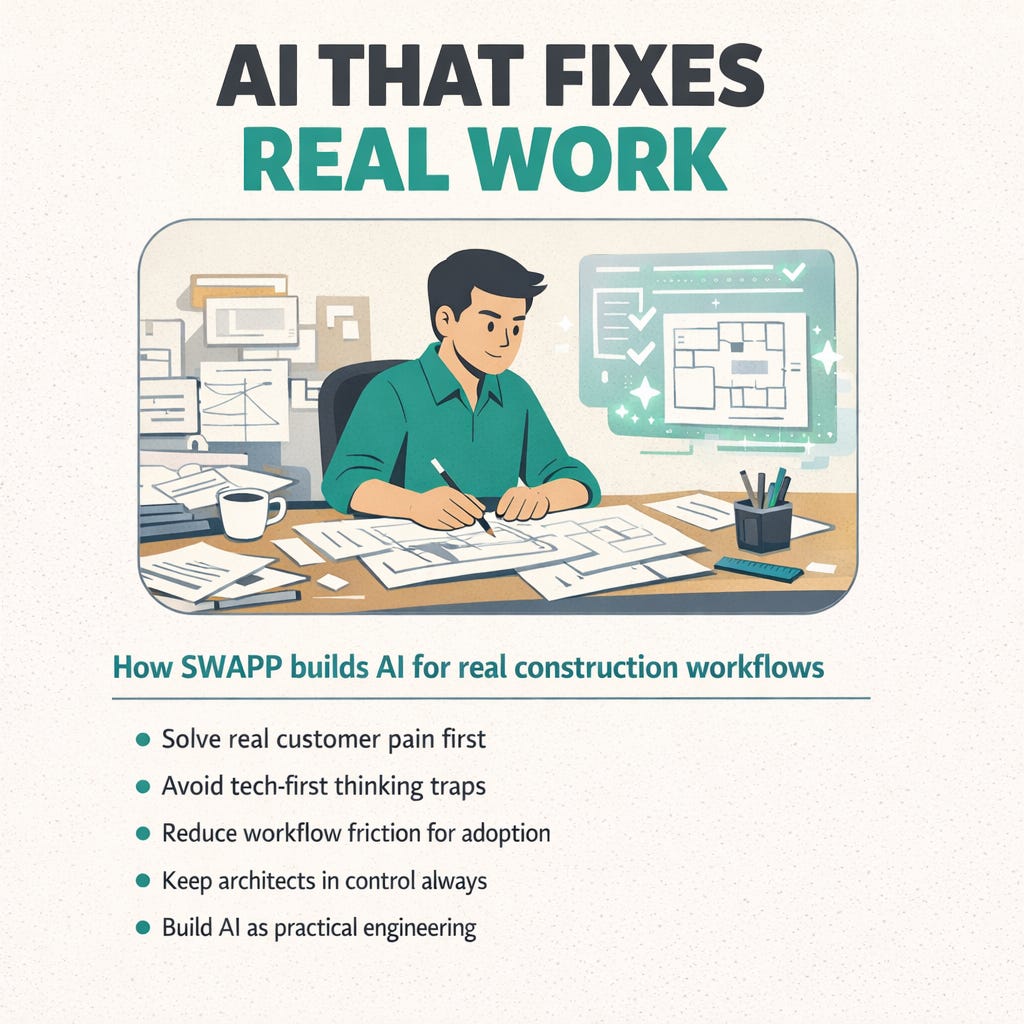
What a 25-Year AI Veteran Learned About Building Tech That Actually Solves Problems
There is a version of the AI conversation that is all hype. Breathless headlines, viral demos, ChatGPT screenshots flooding your LinkedIn feed. And then there is the version that Adi Shavit has been living for the past 25 years, before any of this was fashionable, before the term “AI” became a marketing badge that every software company slaps on their homepage.
Adi is the CTO and co-founder of SWAPP, a platform that automates the most tedious parts of architectural and engineering work. Things like construction documentation, annotations, and the repetitive design tasks that eat up hours of a skilled professional’s day. Before SWAPP, he co-founded a company that was eventually acquired by Autodesk. Before that, he spent nearly a decade embedding real-time computer vision systems inside a Japanese tech company.
He was solving what we now call AI problems when most people thought AI was science fiction. And when someone like that talks about what actually works in building technology and growing a company around it, it is worth paying close attention.
Here is what stood out from a recent conversation with Adi, and more importantly, what it means for you as a business owner trying to grow and scale.
The Technology Is Never the Point
This is probably the most counterintuitive thing Adi said, given that he has spent decades writing code and designing algorithms.
“I never fall in love with algorithms. The technology is the enabler. It empowers actual solutions for customers.”
What he means is simple. It does not matter how clever your solution is if it is not solving a real problem for a real person. And the mistake a lot of technically minded founders make, one Adi admits to learning the hard way, is building first and then looking for a customer to validate it later.
He describes seeing founders with a technology looking for a problem. It is the startup equivalent of buying a hammer and wandering around hoping to find a nail.
The better model, which Adi has built SWAPP around, is the opposite. You start with pain. You find people experiencing a specific, recurring, frustrating problem. You understand the edges and nuance of that problem deeply. And then, only then, you build the simplest possible solution that actually addresses it.
“I will always choose the simplest solution because it is easier to maintain, easier to upgrade, easier to handle, easier to expand.”
For business owners, this mindset shift matters well beyond tech. Before you invest in a new tool, a new hire, or a new offering, ask yourself honestly: are you starting from a customer pain, or from something shiny you want to build?
What Happened When SWAPP Entered Construction
After Adi and his co-founder Ethan sold their previous company to Autodesk, they spent time working inside the organization. That turned out to be one of the most valuable learning experiences they had, not because of what was working in the industry, but because of what was not.
The architecture, engineering, and construction world is one of the most documentation-heavy industries on the planet. Before a single wall gets built, there are thousands of pages of drawings, specifications, annotations, and coordination documents that have to be produced, reviewed, updated, and passed between dozens of stakeholders.
A huge chunk of that work was being done manually. Architects who spent years developing design and problem-solving skills were spending seven, eight, nine hours a day moving lines on a screen and filling in annotations. Engineers were manually transferring data between software platforms, losing time and introducing errors at every single handoff.
“Construction documents was a bottleneck that nobody was actually touching,” Adi said. He remembered a fellow founder telling him that everyone in the industry knew this problem existed but nobody wanted to go near it because of the complexity involved. That complexity was exactly what drew Adi in.
SWAPP was built to automate the parts of this workflow that do not require a human brain. The repetitive, mechanical, rule-based documentation tasks. Meanwhile, the judgment calls, the design decisions, and the creative problem solving stay firmly in the hands of the professionals doing the work.
Never Guess Intent: The Product Principle That Changes Everything
One of the clearest principles Adi shared is something SWAPP built into the system from day one. The system never guesses intent.
Here is what that means in practice. An architect working on a building project is operating under an enormous set of constraints. Building codes, client preferences, site conditions, structural requirements, aesthetic decisions. No software system could ever fully understand or infer all of that context. It is too rich, too nuanced, too human.
So rather than having SWAPP’s AI try to make design decisions on behalf of the architect, the system handles the execution of tedious tasks while the architect maintains control over everything that actually requires expertise and judgment.
Think about the difference between software that says “we figured out what you want and did it” versus software that says “we handled the boring parts, here is what needs your attention.” The first one sounds impressive in a demo. The second one is what professionals actually want to use every day.
“Nobody, there is no best,” Adi said, explaining why SWAPP does not try to suggest optimal solutions. “For every context there may be many different optimal situations, but the architect always knows best.”
This is a useful lens for any tool you bring into your own business. The best software does not make decisions for you. It removes friction from decisions you are already making. If a tool is trying to replace your judgment rather than support it, that is worth examining carefully before you commit.
Why “Our KPIs Are Our Customers’ ROIs” Is More Than a Tagline
Adi used this phrase during the conversation and it landed differently than most things companies say about customer success.
“Our KPIs are our customers’ ROIs. Our key performance indicators are our customers’ return on investment.”
It sounds like something from an About page. But the thinking behind it is actually a structural business decision.
SWAPP’s incentives are built around making their algorithms faster, more accurate, and cheaper to run. Every improvement on that front directly translates to better outcomes for customers. Shorter turnaround times, fewer errors, lower cost per project. There is no tension between what is good for SWAPP and what is good for the customer. The interests are genuinely the same.
The consequence of this is powerful. When customers experience real ROI from using SWAPP, they do not just renew. They become advocates inside their organizations. They introduce SWAPP to other departments. They refer other firms. They provide detailed feedback that makes the product sharper.
“Once your customers become your champions, they also understand that providing feedback really affects where the product is going.”
This is the kind of growth that does not need a massive sales team or expensive outbound marketing. It needs a product that genuinely works and an incentive structure that is honest enough for customers to trust the relationship.
The Friction Problem Nobody Talks About Enough
When SWAPP works with architecture and engineering firms, they are often selling into large enterprise organizations. And one thing Adi and his team learned from the Autodesk experience is how differently large companies approach software adoption compared to small studios or solo practitioners.
There is an IT department that vets every tool. There are procurement processes. There are data security reviews. There are stakeholders who were not part of the original decision but whose daily work gets disrupted by it.
This shapes how SWAPP approaches go-to-market in a very practical way. The goal is always to reduce friction. Specifically, to minimize how much the software disrupts the existing workflow before the customer gets value from it.
“You cannot educate a full industry,” Adi said directly. And this is something a lot of startups get wrong. They build a solution that is genuinely better but requires the customer to fundamentally change how they work in order to experience that benefit. Adoption becomes painful and slow.
SWAPP’s response has been to move increasingly toward working within the tools architects and engineers already use. Revit, BIM software, existing design environments. Rather than asking users to export data into SWAPP, work in SWAPP, and then bring it back into their main tools, the goal is to deliver value inside the environment the user already lives in.
It is harder to build that way. Different SDKs, different APIs, different vendor environments, different programming languages. But the payoff in terms of adoption and customer satisfaction is real.
For any business owner building a product or service: how many steps does your customer have to take before they get value from what you are selling? Every extra step is a place where people drop off.
The Stealth Startup Trap
This one surprised me, coming from a deep-tech founder. Adi was pretty direct about it.
“The whole concept of stealth is usually oversold for many situations.”
The conventional startup wisdom says you keep your idea secret until you are ready to launch, protecting your competitive advantage and perfecting the product before anyone sees it. Adi’s experience has pushed him strongly in the other direction.
“Go and speak to your users. Even if you have gone through the same thing yourself, different people perceive and use the same tools differently.”
The real risk of stealth is not that someone will steal your idea. It is that you will spend months or years building something that does not match what real users actually need, because you assumed you already understood the problem and nobody was around to correct you.
The better approach is to move quickly, yes, but not silently from your customers. Be very open with the people who are experiencing the problem you are trying to solve. Their feedback is what separates a product that works from one that almost works.
How a 25-Year AI Veteran Actually Thinks About AI Right Now
Given Adi’s background, you might expect either cynicism or mania. What you actually get is something more grounded.
“It is not as magic as some people might have you believe. It is engineering. Algorithms that must be correct, performant, trustworthy, and still bring value where previous approaches could not.”
He is genuinely enthusiastic about what modern AI tools can do, particularly for software development. He uses AI coding tools heavily and actively teaches his team best practices around them. But not as a replacement for engineering judgment. As a multiplier for what his team can produce.
“I do not think AI is going to replace developers. We have never been busier. It is more about changing the way we work.”
That framing applies to most industries. The question for business owners is not whether AI will replace your team. The more useful question is which parts of your team’s work are repetitive, rule-based, and do not require human judgment. Those are the parts worth looking at first. The rest stays human.
The 15th-Century Engineer Who Understood the Real Job
In the rapid-fire part of the conversation, Adi was asked about a book that made a big impact on him. His answer was unexpected.
“Brunelleschi’s Dome. It is about an engineer who solved one of the greatest construction challenges of his era by thinking about the problem differently than everyone in his guild.”
Filippo Brunelleschi built the famous dome on the Florence Cathedral roughly 600 years ago. The project was considered impossible by the architects and craftsmen of the time. Brunelleschi figured it out by refusing to assume the existing approaches were the only approaches.
The parallel to how Adi thinks is clear. The best solutions to complex problems often come from people willing to look at things differently, who have the technical depth to execute on an unconventional idea, and who are not too attached to how things have always been done.
And often, the problems that seem too complex to touch are exactly the ones most worth solving.
What This Means for Your Business
You are probably not building software for the architecture industry. But these principles travel.
Start with the pain, not the technology. The tool is never the point. The problem it solves is. Go talk to the people experiencing the problem you are trying to solve, even if you think you already understand it. Especially if you think you already understand it.
Build the simplest solution that actually works. Sophistication is fine. Maintainability is better.
Make sure your incentives are genuinely aligned with your customers’ outcomes. When they win, you win. When that is structurally true rather than just something you say in your pitch deck, customers feel it and they respond to it.
Reduce friction at every step. Every extra click, every workflow interruption, every piece of data that has to move between systems manually is a reason someone might not bother.
Stay close to where your market is heading. Not so you can chase every trend, but so you can position yourself ahead of what is coming rather than scrambling to react to it.
Adi has been watching AI evolve for longer than most people in this conversation have been paying attention to it. His view is that it is real, it is accelerating, and it will change how work gets done across most industries. But the businesses that benefit most will not necessarily be the ones with the flashiest AI features. They will be the ones who understood their customer’s real problem first and built around that.
That part has not changed in 25 years. And Adi does not expect it to.
If you are exploring ai in construction or need support in GTM for your construction tech startup, book a discovery call using this link :
https://calendly.com/mayur-mistry7/consultancy-discovery-call
If this journey speaks to you, you’ll get even more from the complete episode.
🎧 Listen here for more episodes: