
Lessons from StructShare’s Trimble Acquisition by Or Lakritz
Discover how StructShare’s founders built, scaled, and exited to Trimble—sharing real lessons on resilience, product-market fit, and startup focus.

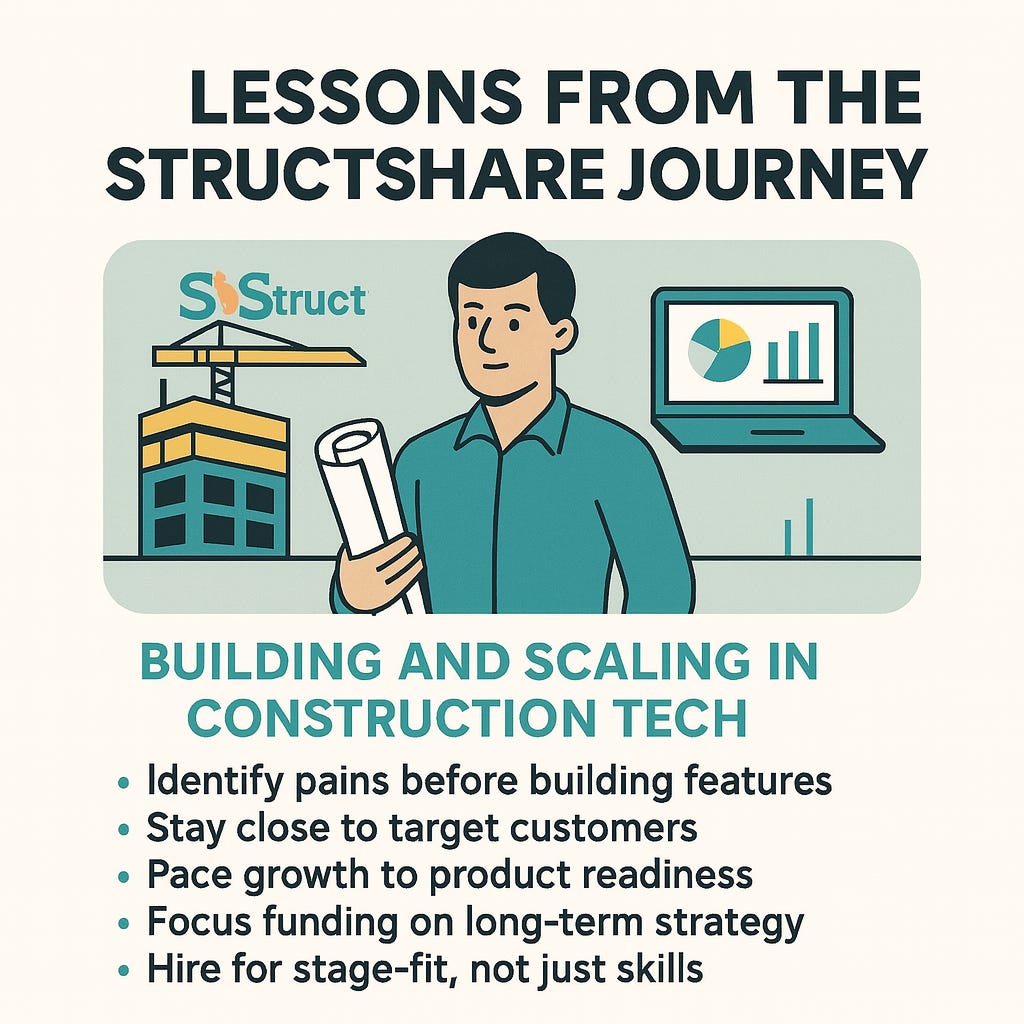
The Trojan Horse Strategy: Lessons from StructShare’s Trimble Acquisition
When Or Lakritz co-founded StructShare, he didn’t step into an industry known for innovation.
He stepped into construction — one of the world’s largest yet least digitized sectors.
Eight years later, that same startup was acquired by Trimble, a global leader in construction technology.
This isn’t your typical “we built it, they bought it” story.
It’s a blueprint for founders who build in hard, traditional industries — where every deal is a battle and every “yes” takes months to earn.
Let’s unpack what Or’s journey teaches us about building resilience, earning customer trust, and scaling when the odds (and spreadsheets) say you shouldn’t.
1. Finding Clarity in a Chaotic Industry
Or didn’t come from construction.
He was a computer science and psychology graduate who spent years in strategy consulting — helping startups with product, marketing, and digital transformation.
Then he met his co-founder Arik Davidi, a construction veteran, and everything changed.
“In construction, there’s no common practice,” Arik told him.
“Every contractor does things differently.”
That line stuck.
Where most outsiders saw chaos, Or saw opportunity — specifically in how procurement and supply chains were managed.
They began by studying how materials, specs, and approvals flowed through projects.
The insight? A mountain of data existed — but none of it flowed cleanly between the field and the office.
So they built their first MVP around that pain point:
a mobile + office app that streamlined purchase orders for specialty contractors.
Or called it their Trojan Horse — a small but vital wedge into the customer’s workflow.
“We realized we couldn’t digitize the whole industry overnight.
We needed one specific entry point that solved something now.”
That mindset — narrow pain, immediate value — became StructShare’s foundation.
2. Doing the Unscalable — and Winning
Every founder has heard Paul Graham’s advice: “Do things that don’t scale.”
StructShare took that literally.
When customers wanted dashboards to visualize purchasing data, the team didn’t have bandwidth to automate it.
So someone manually exported data, built the dashboard by hand, and published it daily.
Every. Single. Day.
It was slow, human, and unsustainable.
But it built trust.
Clients saw value instantly, and StructShare bought itself time to build the automated version later.
Lesson for business owners: sometimes, you win not by scaling faster — but by serving deeper, even if it means dirty work.
3. Enduring the “Downs and Downs”
When asked about low points, Or laughed:
“A founder’s journey isn’t ups and downs.
It’s downs and downs… and maybe one up at the end.”
COVID was that breaking point.
StructShare had secured a funding round — three of four investors had signed the term sheet.
Then the fourth pulled out, and the round collapsed.
The team slashed salaries, went half-time, and survived purely on conviction.
No one quit.
That collective belief became their real competitive advantage.
Resilience isn’t a buzzword when you’re wiring payroll with three weeks of runway.
It’s survival — and it builds the kind of loyalty that no salary can buy.
4. The False Signal of Product-Market Fit
A few years in, StructShare’s sales looked strong.
They were closing 40–50 % of demos.
That kind of conversion can make any founder feel invincible.
So they ramped up marketing, hired sales reps, and poured money into growth.
Then reality hit.
Retention lagged. Usage was inconsistent.
They hadn’t achieved true product-market fit — just early traction.
“We thought we had fit,” Or admitted.
“What we had was momentum in a small pond.”
The cost?
Months of wasted marketing spend and a painful reset.
Lesson: Don’t scale your message before you’ve nailed your usage.
Acquisition metrics can lie; engagement doesn’t.
5. Hiring for Fit, Not Flash
Hiring in construction tech is tricky.
Should you hire someone from a big incumbent — or a startup outsider with fresh perspective?
Or’s take: match the person to your stage, not your dream.
He once paid top-tier salaries for talent from major construction software companies.
But not all could thrive in a startup’s chaos.
“Sometimes it’s better to pay more for the right fit than less for the wrong one,” he said.
“You don’t save money by hiring cheap; you burn time by hiring wrong.”
The best hires weren’t just qualified. They were adaptable, patient, and unafraid of ambiguity — traits every founder should prioritize over prestige.
6. Be Close to Your Market — Literally
Before remote selling was mainstream, Or and Arik flew back and forth from Israel to the U.S. constantly.
They met customers on job sites, not Zoom calls.
Or practically lived in New York, spending two-to-three weeks a month there.
That proximity gave StructShare something data couldn’t: context.
They saw how contractors worked, where digital tools failed, and how workflows really unfolded.
Eventually, they built a distributed model:
Israel: Product + R&D leadership
Ukraine: Development + QA
U.S.: Sales + Customer operations
That structure (no pun intended) kept them close to customers and nimble in execution.
For business owners everywhere: you can outsource code, not understanding.
Stay close to the people you serve.
7. Fundraising: From Chase to Strategy
Early fundraising was brutal.
Construction tech wasn’t “sexy.” Investors didn’t get it.
StructShare often chased cash before clarifying strategy — a treadmill Or now warns founders against.
“Don’t run after money and then define your milestones.
Define your milestones so money runs after you.”
His advice for founders pitching investors:
Craft your narrative. Why you, why now, why this customer?
Show progress, not perfection. Early signals of retention matter more than fancy decks.
Stay realistic. VCs back believable growth, not blind ambition.
The best fundraising stories are grounded in credibility, not charisma.
8. The Acquisition Playbook
When Trimble entered the picture, StructShare wasn’t hunting for an exit — they were building momentum.
But preparation met opportunity.
“You need to know why they’d want to buy you,” Or said.
“Not just why you want to sell.”
Trimble saw alignment: product, customers, and team culture.
For StructShare, the acquisition wasn’t an ending — it was a continuation under a bigger umbrella.
Acquisitions aren’t luck.
They’re a reflection of how clearly your company tells its story — both in numbers and in narrative.
9. What Every Founder Can Steal from This Story
Or’s journey distills into a few truths every business owner — construction or not — can apply:
Start narrow. Big visions begin with small, undeniable pains.
Do unscalable work. Manual dashboards, hand-held customers — that’s the bridge to trust.
Pause often. Run, pause, reflect. Growth is an interval sport, not a sprint.
Validate retention before expansion. Engagement is the ultimate truth.
Be near your customers. Geography matters until trust scales.
Raise with purpose, not panic. Money follows clarity.
And above all remember that every “overnight success” was built on thousands of tiny, invisible moments of persistence.
Or Lakritz’s approach shows that in industries with complex workflows, growth doesn’t only come from innovation it comes from making that innovation understandable and actionable for the people who need it most.
If this journey speaks to you, you’ll get even more from the complete episode.
🎧 Listen here for more episodes:
Spotify | Apple | Youtube | Season 5