
How Smortr Is Redefining Construction Data by Yashasvini Gopalan
Architect-turned-founder Yashasvini Gopalan shares how Smortr simplifies construction coordination through data visualization and design thinking.

Architecture School: Where Systems Thinking Begins
Most startup founders come from tech, not tectonics. But Yashasvini Gopalan, co-founder of Smortr, started in the design studio not a startup accelerator.
Growing up in Chennai, she literally saw her school being built while attending it a living construction site that sparked her fascination with how design shapes human experience. She pursued architecture, drawn by the desire to impact lives through space.
Architecture school started with imagination impossible cliffside projects that bent gravity and logic but quickly grounded her in the realities of constraints: regulations, spatial limits, budgets, and structure.
Those constraints taught her something fundamental that the real power of design lies in understanding complex systems. That mindset of pattern recognition and process awareness would later define her approach to building technology.
Data at Home, Design at Work
While studying architecture, Yashasvini was also exposed to IoT and data systems through her family’s tech company. Dinner conversations often revolved around data monitoring, sensors, and interoperability topics rare for an architecture student.
So while her classmates focused on sketches, she was asking:
“How do systems physical and digital talk to each other?”
That question followed her into her early projects. Whether working on a hospital or a factory, she noticed how disjointed the workflow was. Drawings, revisions, attachments all scattered across emails and drives.
It made her wonder: why are design and data living in two separate worlds?
Early Entrepreneurship: Designing Beyond Buildings
Before Smortr, Yashasvini and her brother co-founded a design studio called Dezavu. They handled everything from interior architecture to product design for corporate clients.
Through that work, she gained exposure to a wide range of industries and more importantly, to how decision-makers think.
Each project highlighted the same frustration: the lack of coherent systems for managing data and feedback. That realization became the first thread connecting her design training to her future in technology.
From Design Studio to Data Systems
Later, Yashasvini moved to the Bay Area, where she began collaborating with startups, helping them with marketing, design, and strategy. Many of these companies targeted legacy industries plagued by data fragmentation manufacturing, logistics, and construction among them.
That overlap was eye-opening. Even across sectors, one pattern persisted:
the bigger the system, the more broken the communication.
It reminded her of construction countless files, formats, and revisions scattered across tools. That realization became the conceptual seed for what would evolve into Smortr.
The Birth of Smortr
Smortr wasn’t born overnight. During the pandemic, Yashasvini and her college friend Surya began discussing how to make the construction industry more digitally connected.
Their first prototype wasn’t what Smortr is today. It started as a LinkedIn for construction professionals a place for builders, architects, and engineers to network and share projects.
But after dozens of interviews, they discovered that visibility wasn’t the real issue.
Coordination was.
Across both India and the U.S., the problem was the same:
construction teams were drowning in version chaos. Hundreds of PDFs, endless email threads, and zero version control.
That’s when Smortr shifted focus from connection to collaboration.
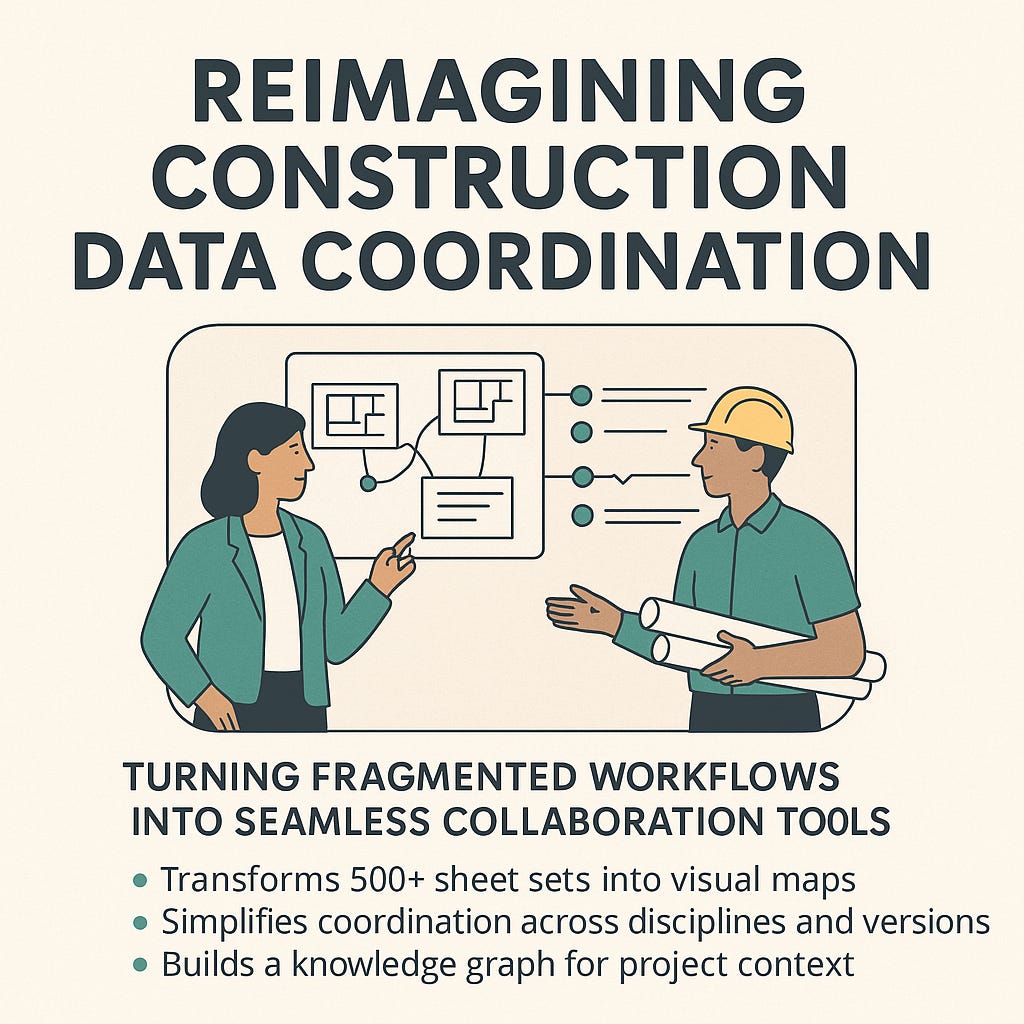
Reimagining Coordination: A “Google Maps” for Drawings
Smortr’s core idea was deceptively simple:
make it as intuitive to navigate construction drawings as it is to explore a map.
Instead of streets, users move between plans, sections, and elevations.
Instead of buildings, they zoom into levels, spaces, and elements.
And instead of time zones, they navigate versions over time understanding what changed, when, and by whom.
Yashasvini explains:
“Even though many teams work in 3D, coordination still happens in 2D. We wanted to make that experience visual, fast, and version-aware.”
Smortr even built an AI-powered indexing layer that extracts metadata (discipline, drawing type, scale) directly from files while inviting human input when nuance is needed.
It’s automation with context, not automation without control.
The Deeper Vision: Turning Conversations into Context
While the interface is intuitive, the real innovation is happening behind the scenes.
Smortr’s long-term vision is to create a knowledge graph that connects drawings, discussions, and decisions effectively turning every project into a searchable memory.
Imagine this:
An architect emails an electrical consultant, “Don’t put the switch here a shelf will go later.”
That insight disappears in inboxes forever.
Smortr’s goal? Capture and link that context automatically.
So future teams can not only see what changed but why.
It’s not just document management. It’s institutional memory for the built world.
Learning the Hard Way
Every founder knows that solving hard problems means facing hard lessons.
For Smortr, the technical challenge was handling massive PDFs balancing usability, rendering speed, and precision.
But the strategic challenge was even harder: deciding what not to build.
“We don’t want to reinvent Autodesk or Bluebeam,” Yashasvini says.
“We want to empower the smaller players who can’t access those tools and help them collaborate better.”
That clarity focusing on who you’re building for kept the team grounded and resource-efficient.
A Founder’s Playbook: Finding the “Head-on-Fire” Problem
When asked how she’d start from scratch, Yashasvini shared a timeless startup lesson:
“Find one customer with a head-on-fire problem. Sit with them. Understand their workflow. Build small versions fast.”
Smortr’s early prototypes used the Wizard of Oz method the backend was manual, but the frontend felt like a finished product. This allowed them to validate fast, gather real feedback, and refine their direction before scaling.
It’s a reminder for every entrepreneur: Don’t fall in love with your idea fall in love with your user’s pain.
1Architectural Thinking for Founders
Architecture may seem distant from software, but in practice, the parallels are profound.
In both, you must:
Design for constraints.
Iterate through failure.
Balance form and function.
Create systems that serve people.
Yashasvini’s architectural foundation shaped how she builds products not just for usability, but for human experience.
Smortr’s interface isn’t just data-driven; it’s designer-driven intuitive, visual, and empathetic.
The Future of Construction Tech
The AEC world is finally catching up to digital transformation.
When Yashasvini started, she had to convince people to talk about construction tech.
Today, tech professionals outside the industry are joining those conversations.
She’s inspired by emerging players like Trunk Tools, who are reshaping construction culture and making it more Gen Z-friendly energetic, open, and collaborative.
As Smortr continues to evolve, it’s not just building features it’s building a bridge between design intent and data intelligence.
Final Reflection
Smortr’s story is about more than just managing drawings it’s about designing clarity.
Yashasvini’s path from architecture to tech shows what happens when you combine deep empathy, systems thinking, and relentless iteration.
Whether you’re designing a building or a business, the process is the same:
Start with structure. Build with people. Iterate toward understanding.
Because in the end, the smartest systems are the ones that make collaboration effortless.
If this journey speaks to you, you’ll get even more from the complete episode.
🎧 Listen here for more episodes: