
How to Scale Your Business: Lessons from 50+ Startups by Jameson Hartman
A VC managing 50+ companies reveals why incremental wins beat revolutionary ideas, how to win enterprise clients, and tactics that actually scale.

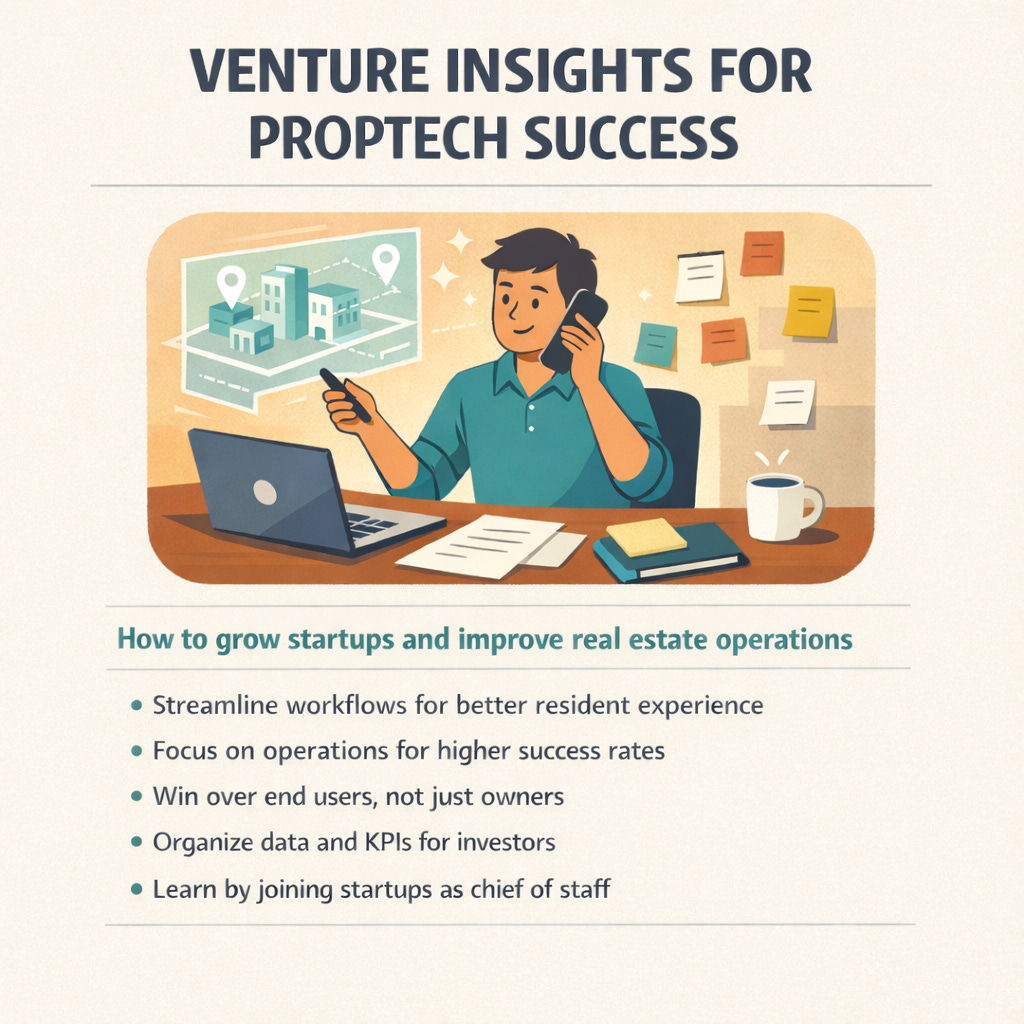
The Hidden Patterns Behind Businesses That Actually Scale: What 50+ Companies Taught a Venture Capitalist
Why your revolutionary idea is probably wrong, and what works instead
Every business owner faces the same pivotal moment. You’re in a meeting with your biggest potential client yet. They ask if you can deliver something you’ve been planning but haven’t built. Your pulse quickens. And you hear yourself making promises that sound confident but are, frankly, aspirational.
Jameson Hartman, Vice President at RET Ventures, watches this scenario unfold constantly. His fund manages approximately 50 portfolio companies in construction and real estate technology, investing at the Series A stage when companies have proven product-market fit and are generating $1-3 million in revenue. What he’s learned from being embedded in these businesses offers a complete playbook for scaling applicable far beyond real estate.
Why Your Revolutionary Idea Probably Won’t Scale (And What Will)
Let’s address an uncomfortable truth: your disruptive innovation likely isn’t as valuable as incremental improvement.
RET Ventures evaluates hundreds of companies attempting to revolutionize real estate and construction. Founders present compelling visions modular housing that changes everything, AI replacing entire workflows, platforms making legacy systems obsolete. The pitch decks are polished. The vision is bold. The failure rate is massive.
“The opportunity for the most disruption is obviously going to be earlier, on the construction side,” Hartman explains. “That’s why you see construction tech companies raise a lot of money because it is this binary outcome. You’re either a crazy success or people just don’t adopt you and you burn millions of dollars.”
What actually works: incremental improvement.
One RET portfolio company focused on a seemingly mundane problem reducing apartment turnover time between residents. They helped property owners decrease the average from five days to three days. Just two days. The financial impact? Several million dollars annually per property owner.
Consider this for your business: What’s your equivalent “turn time”? Client onboarding duration? Production cycles? Feature deployment speed? The winners aren’t promising complete process reinvention they’re eliminating two days from your existing workflow.
“You don’t have to reinvent the wheel,” Hartman notes. “You just have to make it slightly more efficient. And it’s easier to do that in operations than it is with building.”
The probability-adjusted value favors operational improvements over transformative innovation. While construction technology might offer 10x returns, the success rate is 5%. Operational efficiency might offer 3x returns with a 60% success rate. Do the math.
The Boots-on-the-Ground Problem: Why Perfect Solutions Fail
Here’s a pattern that repeats across industries: A founder builds something brilliant that saves substantial money. The CEO endorses it. The CFO approves the budget. Then it dies slowly because the people using it daily... don’t want to.
This is the boots-on-the-ground problem, and it kills more businesses than inferior technology.
“Our portfolio companies that are successful are very good at winning the boots on the ground,” Hartman explains. “I’m selling to you, you’re the CEO of a company. You might love my product, but if the actual users don’t love my product, it’s going to have a lot of uphill battles to get adoption.”
The Excel principle: We all acknowledge better tools exist more modern, more powerful. Yet we continue using Excel because we’re comfortable with it, our workflows depend on it, and everything integrates with it.
Successful companies don’t fight this inertia they leverage it. Their pitch: “Keep using Excel. We’re making your Excel usage more efficient.” That sells. “Replace Excel with this completely new system” fails, regardless of technical superiority.
For your business, map everyone whose daily routine changes when they adopt your solution. It’s rarely just the decision-maker signing the contract. Ensure your solution genuinely simplifies their work not just theoretically improves it.
Finding Your Million-Dollar Friction Point
RET Ventures has a unique advantage: their limited partners (LPs) include major REITs like UDR, Essex, MidAmerica, and CenterSpace. This means testing ideas against 50+ organizations before investing essentially 50 parallel focus groups for every concept.
“A corporate VC might go to their marketing team for feedback on a product one marketing team,” Hartman explains. “We can go to 50 marketing teams. Does that mean we can control them and they will use every product we invest in? No, but we’d like to think we have a pretty good wisdom of the crowds approach.”
This approach reveals crucial insight: The problems appearing biggest often aren’t where you add the most value.
Currently, RET focuses on the “seamless workflow” making apartment hunting and move-in as frictionless as using Robinhood for stock trading. No passport scanning. No mailing 70-page leases. No friction.
But here’s what matters: This isn’t one problem it’s dozens of small friction points. Each represents a business opportunity.
“A lot of technology solutions that integrate and make that entire resident lifecycle more seamless that’s really where we’re looking, because that enhances the conversion rate of prospects and enhances the resident experience.”
Your action item: Map your complete customer journey. Identify every friction point. Each one potentially generates significant revenue. Don’t attempt solving everything simultaneously master eliminating one specific friction point.
The Fatal Mistake: When Overselling Destroys Future Opportunities
The mistake Hartman sees costing companies their futures: overselling capabilities to secure deals.
“Companies will overreach on what they can or think they can do to get in front of customers,” he explains. “Sure, you get the demo, sure you get the pilot, but if you’re pitching something you’re not going to succeed at executing on, you’re losing that lead forever.”
The alternative approach: Strategic honesty.
When prospects request unavailable features, don’t pretend you have them. Don’t softly imply they’re “coming soon” without certainty. Instead: “We don’t do that today, but it’s on our roadmap. We’d love for you to be a development partner helping us build this.”
The difference is substantial. Scenario one: You secure a pilot, fail delivery, and permanently damage the relationship. Scenario two: You build trust, potentially gain a development partner shaping your product, and create a customer invested in your success.
“Those customers are much more likely to come back to you at a later date,” Hartman notes. “There’s the long-run, short-term mindset. Founders with more of a sales lens want to be short-term. That road, you don’t want to go down.”
Winning Enterprise Clients with Limited Resources
Let’s address what most advice ignores: How do you serve major clients without adequate resources?
Hartman’s answer: Accept lower margins temporarily.
“You might be selling something for a dollar and it’s going to cost you 99 cents instead of 80 cents,” he explains. “You might even sell something for a dollar that costs you a dollar and five cents, with the hope that as you scale up, you’ll negotiate and get your costs down.”
This isn’t perpetual unprofitability it’s understanding margins improve with scale, and securing the right client at thin margins beats not securing them at all.
“We’re okay if somebody’s margins are at 20% and they creep up to 30, 40, 50, 60, because they got the client and the client’s happy,” Hartman says. “That’s better than saying, ‘We refuse any clients below a 60% contribution margin because it’s not worth our time.’”
The strategic principle: Retaining happy clients while improving unit economics later is easier than watching clients adopt competitors and attempting to win them back.
The Data Foundation That Separates Professionals from Amateurs
Before tactical execution, there’s something foundational successful founders do that struggling ones don’t: maintain obsessive data organization.
“Being very organized with all of your data organized with your KPIs, organized with customer acquisition,” Hartman emphasizes. “If your pitch is that you get them to sign more leases, have the data on how many leases they signed before. Have the case studies. Have all that very clean.”
Most founders focus intensely on serving customers and building product appropriately so. However, they neglect creating infrastructure tracking what actually works. When they need to raise capital, hire executives, or prove value to enterprise prospects, they’re reconstructing stories from memory and scattered spreadsheets.
Establish this infrastructure now:
Customer acquisition by channel with actual costs
Feature usage data showing actual usage versus stated preferences
Customer health metrics predicting churn before occurrence
Specific pain points each customer mentioned pre-purchase
Win/loss data from every sales process
Before/after metrics proving your value proposition
“I think a lot of founders are so focused on the customer which is not a bad thing that they forget about long-term things they should have ready and available if they need to raise capital.”
The Go-to-Market Playbook: Making Value Irrefutable
Here’s the go-to-market strategy that works consistently across RET’s 50 portfolio companies:
Make your value proposition impossible to dispute.
One portfolio company, Our Pet Policy, screens fraudulent emotional support animal certificates. Their entry strategy was brilliant: “We’ll do an audit. Show us all your emotional support animal certificates from the past year, and we’ll show you which ones are fraudulent.”
Immediate. Clear. Irrefutable value. No vague promises about “enhancing resident experience” or “improving quality of life.”
“Whatever your pitch is, make sure it’s tough to refute,” Hartman emphasizes. “If your pitch is the quality of life angle, then have very clean data: ‘Rents grew at the properties we’ve been at. They grew at 50 basis points more than the market.’”
Your implementation framework:
Lead with one metric directly impacting your customer’s bottom line
Provide before/after data proving this metric
Offer free audits or assessments eliminating risk in validating your claim
Companies executing this don’t convince people to try their product. The data does it for them.
Navigating the AI Product Explosion
With AI coding tools democratizing product development, RET has seen surging deal flow. Does this competition fundamentally change the landscape?
“The top of the funnel has widened,” Hartman acknowledges. “There’s more companies coming to market quicker than they otherwise would. But where we sit at the Series A stage is more insulated from that AI bubble dynamic because we really rely on customer feedback.”
Here’s the filter: Most rapidly-built AI products fail upon customer integration, real customer service provision, or edge case handling. The superior solutions emerge.
“It goes from 100% to 20%, and that’s when we start looking at them.”
For your business, the question isn’t “Can someone build this faster with AI?” It’s “Can they build something that integrates into real workflows, handles messy edge cases, and provides support customers need?”
That’s your defensible moat. Not the product the execution surrounding it.
Avoiding Commoditization: Where Everyone Builds the Same Thing
One area Hartman sees rapid commoditization: smart AI chatbots and leasing assistants.
“Every industry-specific leasing chatbot when in theory, could you build that with Claude? Could you have a more agnostic solution?” he questions. “It’s not that it’s saturated. I just think it’s becoming more commoditized, and thus it becomes more saturated because you have many players that can enter the market.”
The trap: You invest months building something industry-specific, only discovering a generalist tool now accomplishes 80% of your functionality in fraction of the time.
The escape: Deepen your integration layer. The AI chatbot is table stakes. Value resides in property management system connections, optimal human handoff timing, and local regulation updates. That’s what’s difficult to replicate.
Building Teams That Understand How Businesses Actually Work
Finally, let’s discuss something that might transform your hiring philosophy.
Hartman took what he calls “the non-traditional route” into venture capital. He wasn’t a career investor. After investment banking at Goldman Sachs working on major transactions like Liberty Property Trust’s acquisition by Prologis, he somewhat accidentally landed at RET Ventures.
His recommendation for developing exceptional operators: “Join a startup. Make yourself indispensable to the CEO. Become the chief of staff.”
Why? Chiefs of staff see everything. They’re embedded in finance, sales, product, and operations. They lack the narrow expertise of a VP of Sales or Head of Engineering they possess broad, practical knowledge of how all pieces interconnect.
“Yes, if you become the head of sales, you could eventually go into VC, but head of sales might not see the technology or finance,” Hartman explains. “The VP of tech might not see finance or sales. A chief of staff role is the gold standard of being in the weeds and seeing many different things.”
Two implications for your business:
First, when hiring, prioritize candidates who’ve been chiefs of staff at startups. They have cross-domain pattern recognition that specialists lack.
Second, when developing internal talent, create rotational programs or chief of staff roles forcing high-potential employees across functions. You’re not just developing future leaders you’re creating people understanding your business at a systems level.
The Three-Pillar Framework for Scaling
If you extract nothing else from Hartman’s experience observing 50 companies grow and fail, remember this framework:
Pillar 1: Incremental Wins Over Revolutionary Vision Find the two-day improvement in your customer’s process. Own it completely. The businesses generating millions aren’t the ones with flashiest pitches they’re the ones eliminating specific, measurable friction.
Pillar 2: Win Users, Not Just Decision-Makers Secure buy-in from people actually using your product daily, not just executives signing contracts. Make their lives incrementally better within existing workflows, not theoretically perfect in reimagined ones.
Pillar 3: Make Value Irrefutable Lead with one metric. Prove it with data. Let results do your selling. Never oversell capabilities strategic honesty builds relationships lasting years, while overpromising burns opportunities permanently.
Your Competitive Moat Isn’t What You Think
The businesses that scale aren’t those with revolutionary technology or impressive pitch decks. They’re the ones finding real problems, solving them incrementally, proving value clearly, and executing consistently.
That’s not sexy. It won’t generate TechCrunch headlines. But it’s what actually works.
Your moat isn’t your product anyone can vibe code a chatbot now. Your moat is integration into 50 different systems, support across all of them, and trust built through honest communication and consistent delivery.
RET Ventures’ approach to strategic investing leveraging 50+ LPs for market validation, focusing on Series A companies with proven product-market fit generating $1-3 million in revenue, and maintaining ~20% ownership stakes reflects this philosophy. They’re not betting on revolutionary ideas. They’re investing in companies demonstrating incremental value that compounds.
Take Action: Audit Your Business Against These Principles
This week, do three things:
Identify your two-day improvement. What specific, measurable friction point can you eliminate for customers? Don’t boil the ocean pick one thing and master it.
Map your boots-on-the-ground users. Who actually has to change behavior for your solution to work? Talk to them. Make sure you’re making their lives genuinely easier, not just theoretically better.
Create your irrefutable value proposition. What’s the one metric you can prove you improve? Get the data. Build the case study. Make it impossible to argue with.
The path to scaling isn’t revolutionary innovation. It’s disciplined execution on incremental improvements that compound over time.
And ultimately, “what actually works” is the only metric that matters.
If you are exploring ai in construction or need support in GTM for your construction tech startup, book a discovery call using this link :
https://calendly.com/mayur-mistry7/consultancy-discovery-call
If this journey speaks to you, you’ll get even more from the complete episode.
🎧 Listen here for more episodes:
Spotify | Apple | Youtube | Season 5
Book a discovery call