
How Multi-Agent AI Fixes Structural Modeling Errors
Learn how multi-agent AI improves accuracy, speed, and reliability in structural modeling workflows for AEC professionals.

Structural modeling isn’t hard because of math.
It’s hard because of process.
A typical workflow involves:
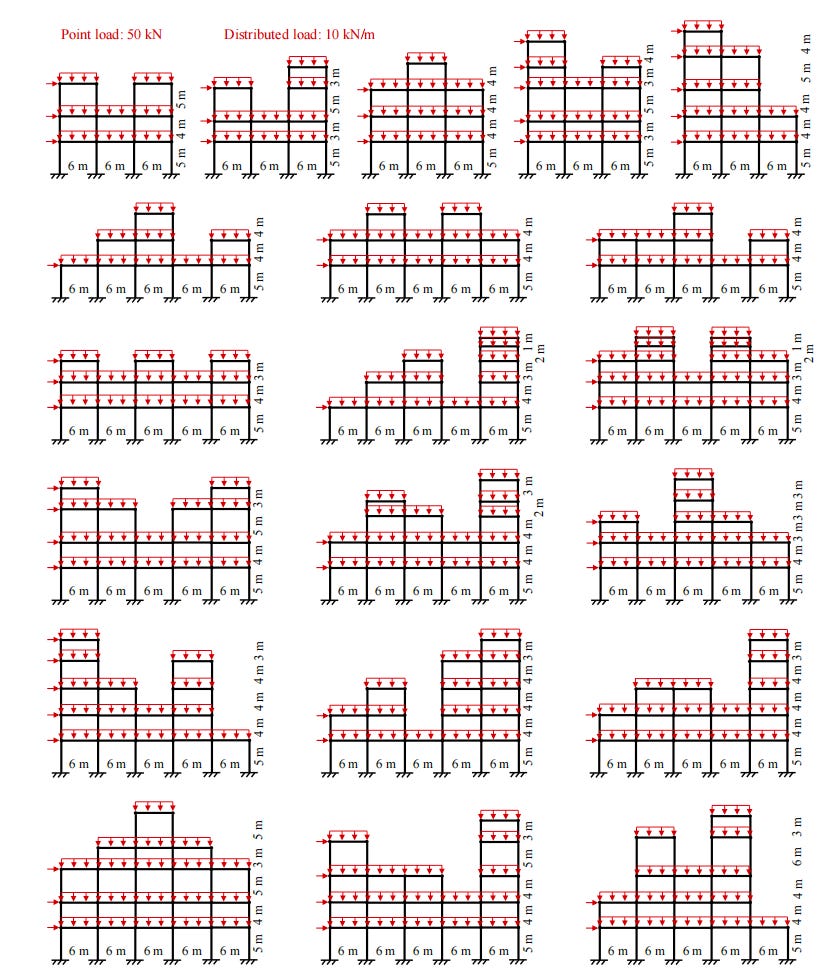
defining geometry
assigning materials
applying loads
ensuring consistency across hundreds of steps
LLMs struggle here not because they “don’t know engineering” —
but because:
👉 they break down in long, multi-step sequences
Small errors compound.
And in structural modeling, that means:
invalid geometry
incorrect loads
unusable analysis scripts
What This Paper Actually Builds
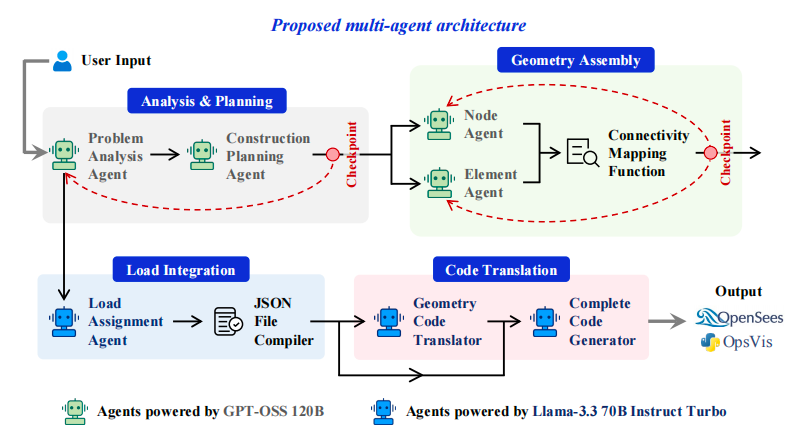
The paper proposes a multi-agent system that splits the workflow into smaller, controlled tasks.
Instead of one model doing everything, it introduces:
1. Analysis & Planning
Two agents handle the front-end reasoning:
Extract structured data from text
Convert it into a standardized format (JSON)
Generate a step-by-step construction plan
📌 Example:
Input:
“3 bays, varying story heights, fixed supports, distributed loads”
Output:
structured geometry
load definitions
ordered construction steps
👉 This reduces ambiguity early.
2. Geometry Assembly (Parallel Execution)
This is one of the most important design decisions.
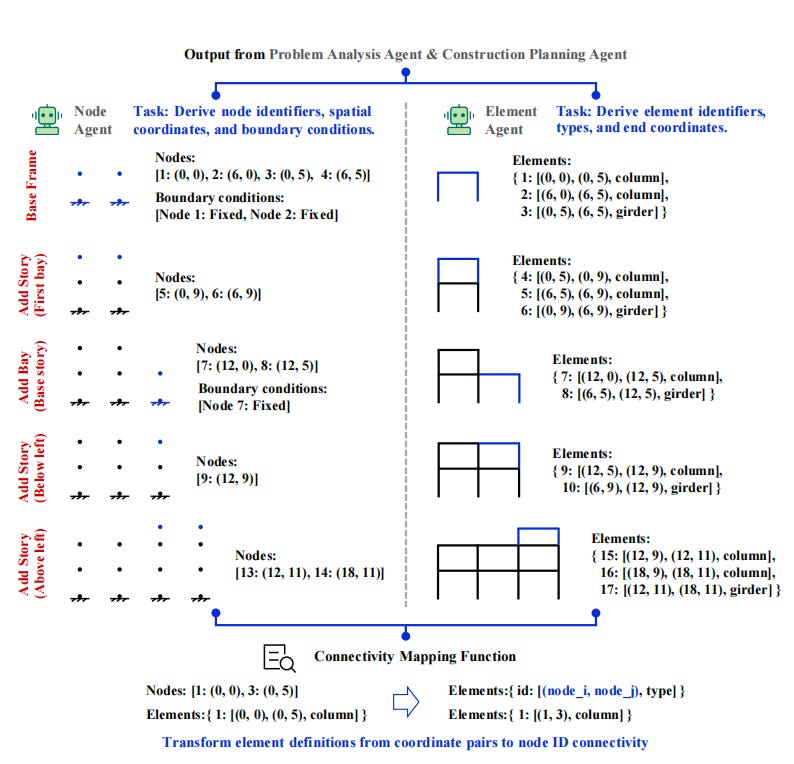
Two agents run in parallel:
Node agent → defines coordinates + supports
Element agent → defines beams/columns
Then:
A mapping function connects them
A validation step checks consistency
📌 Example:
Node exists without element → flagged
Duplicate nodes → removed
👉 This avoids error accumulation from sequential pipelines
3. Load Assignment
This agent converts abstract descriptions into actual model inputs.
📌 Example:
“10 kN/m on beams” → mapped to girder elements
“50 kN at top nodes” → mapped to node IDs
👉 This step ensures loads align with geometry — a common failure point
4. Code Generation (Split into Two Steps)
Instead of generating everything at once:
Agent 1 → converts geometry into code
Agent 2 → assembles full script (loads + config)
👉 This reduces long-context hallucination
Key Design Choices That Matter
1. Checkpoints with Regeneration
At multiple stages:
outputs are validated
errors trigger re-generation (up to 5 retries)
👉 This is how the system avoids cascading failures
2. Task-Specific Models
GPT-based model → reasoning tasks
Llama-based model → translation/mapping
👉 The system doesn’t assume one model is best at everything
3. JSON as the Backbone
All agents communicate through structured JSON.
👉 This makes the workflow:
modular
traceable
debuggable
What Actually Improved
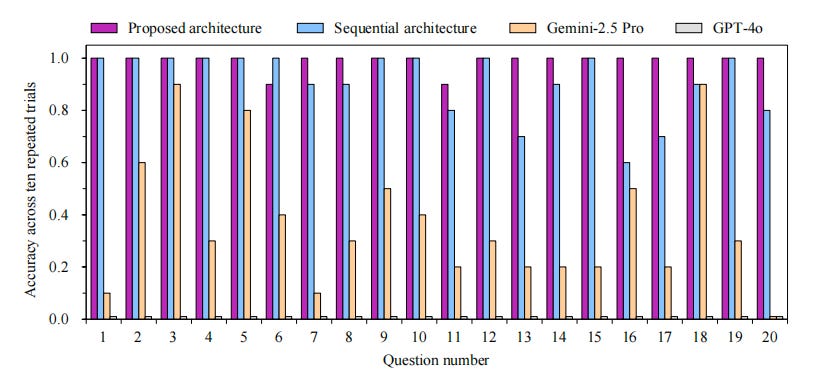
Accuracy
18/20 cases → 100% correct
remaining → 90%
Compared to:
sequential agents → ~60–80% in complex cases
Runtime
Reduced to ~75–194 seconds
Sequential systems: ~269–949 seconds
👉 Major efficiency gain from parallelization
Scalability
Handled:
up to 10-bay, multi-story frames
👉 Sequential systems failed due to timeouts in similar cases
Input Flexibility
Different users described the same problem in:
structured engineering format
gridline-based descriptions
simplified language
👉 System still produced correct results
What This Means for AEC
1. This Reduces Manual Modeling — Not Replaces Engineers
What gets automated:
repetitive setup (nodes, elements, loads)
What stays human:
assumptions
validation
design decisions
2. This Fits Best in Early-Stage Modeling
Use cases today:
rapid structural prototyping
concept validation
educational tools
👉 Not full production design (yet)
3. The Real Value = Reliability, Not Just Automation
Previous AI attempts:
fast but unreliable
This approach:
slightly slower than instant AI
but consistent and verifiable
👉 That’s what makes it usable
4. Where This Could Extend
Based on this architecture, similar patterns could be applied to:
BIM generation workflows
rule-based code checking
structured estimation pipelines
👉 These are potential extensions, not direct claims from the paper
Limitations
Only supports 2D frame structures
No:
bracing systems
nonlinear analysis
dynamic loads (wind/seismic)
Performance depends on:
prompt structure
predefined rules
A Simple Way to Think About It
Instead of asking:
“Can one AI do everything?”
This paper asks:
“What if we break the problem into smaller, reliable steps?”
Final Take
This isn’t a breakthrough in model intelligence.
It’s a breakthrough in system design.
👉 The takeaway for AEC isn’t just “use AI”
👉 It’s how to structure AI workflows so they don’t fail
This blog post is based on research by Ziheng Geng, Jiachen Liu, Ran Cao, Lu Cheng, Dan M. Frangopol, and Minghui Cheng, published in the paper “A Novel Multi-Agent Architecture to Reduce Hallucinations of Large Language Models in Multi-Step Structural Modeling.”
If you are exploring ai in construction or need support in GTM for your construction tech startup, book a discovery call using this link :
https://calendly.com/mayur-mistry7/consultancy-discovery-call