
How Kaizen AI Turned Tech Into a No-Brainer Business Model by Jay Shah
Learn how Jay Shah built Kaizen AI by aligning incentives, removing buyer risk, and transforming deep tech into measurable financial value for developers.

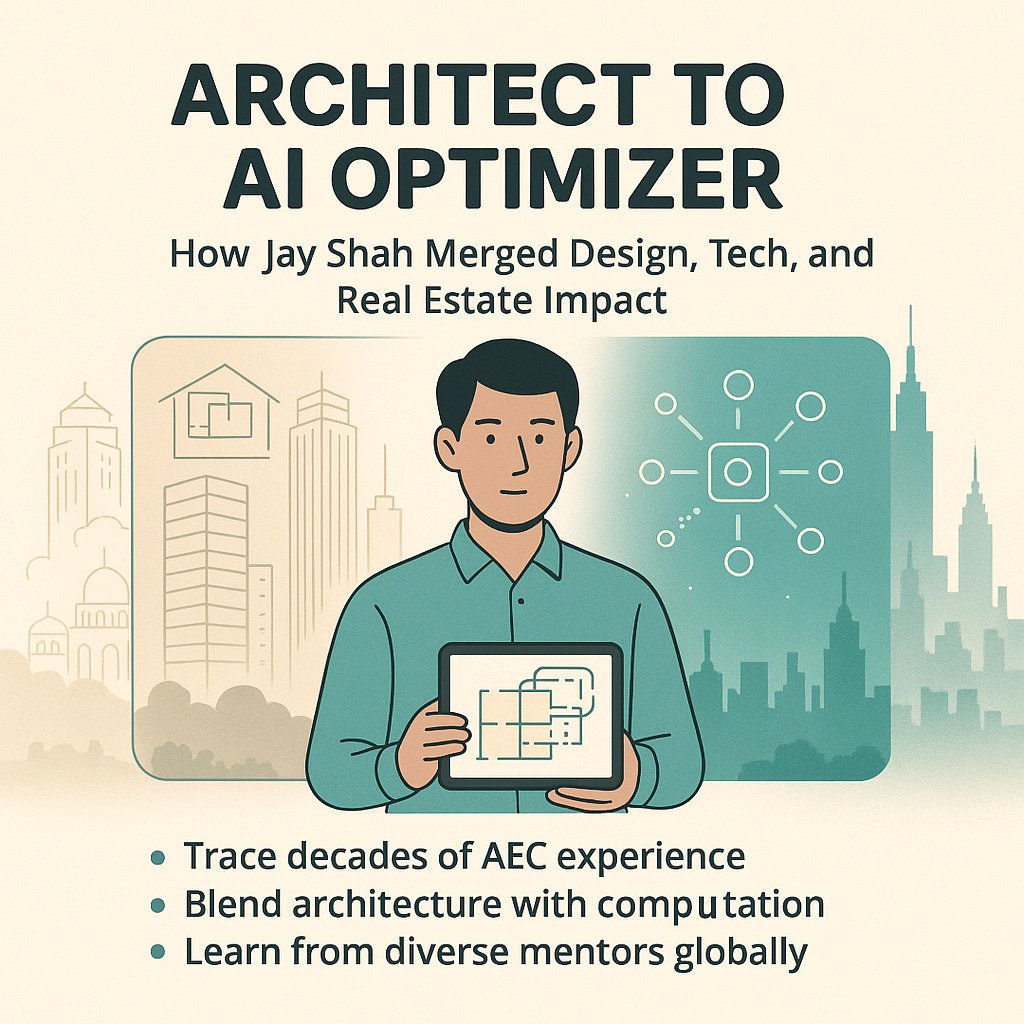
Most founders assume innovation lives inside the product.
Better tech. Better features. Better algorithms.
But Jay Shah, founder of Kaizen AI, learned something far more valuable:
Technology only matters when the business model makes it usable, adoptable, and financially irresistible.
This is the story of how Jay blended architecture, computation, and business thinking to build one of the most quietly impactful optimization engines in real estate and the lessons every business owner can apply today.
1. From Architecture Roots to Deep Tech Builder
Jay grew up inside one of Mumbai’s most respected architecture firms, watching skyscrapers go from idea to construction site before most kids learned algebra. Every Sunday was a field trip to an office or jobsite. He understood early how complex a building really is the coordination, the constraints, the cost sensitivity, the sheer stakes.
Years later, Columbia University amplified that perspective.
He didn’t just study design, he studied:
business
journalism
real estate
computation
This made him dangerous in the best way: a builder who could see multiple points of view inside a single project.
That ability became Kaizen AI’s superpower.
2. The First Startup Failed for the Most Common Reason
Before Kaizen, Jay built an advanced VR visualization platform.
Beautiful. Accurate. Cutting-edge.
And dead on arrival.
Why?
Because while architects loved it, nobody could justify paying for it.
Jay learned his first foundational lesson:
If it doesn’t increase revenue or reduce cost, it’s a luxury not a solution.
This failure pointed him back to a much harder, more meaningful problem:
Developers routinely overshoot construction area, cost, and time and nobody had a scalable way to fix it.
Enter Kaizen AI.
3. The Technology That Produced Jaw-Dropping Results
Kaizen AI uses computational optimization to redesign common areas, parking layouts, and structural efficiencies without changing apartments or elevations (the two things architects protect most).
One project alone delivered:
~500,000 sq ft reduction
20% construction area saved
7–11% reduction in steel and concrete
2 years cut from excavation timelines
34% lifecycle carbon reduction
$45M+ uplift in profitability
This wasn’t theoretical.
This was accepted, built, and sold.
And here’s the important part:
The technology worked from day one.
The business model didn’t.
Because developers still resisted buying.
4. Why Enterprise Buyers Said “No” And How Kaizen Flipped the Script
Even with massive savings on the table, developers refused to pay upfront.
Why?
Their incentives rewarded predictable cost, not experimentation.
Their consultants were paid on total construction value.
Their risk tolerance was near zero.
Their belief was “We already have the best teams we don’t need another tool.”
So Kaizen AI made a radical decision:
No upfront fees. Ever.
Instead, Kaizen introduced a shared-ROI model:
Kaizen runs the optimization at its own cost
The client pays only if they accept and implement the optimized output
Kaizen earns a percentage of realized gains
Suddenly:
no risk
no friction
no excuses
Adoption skyrocketed.
This is one of the clearest business lessons from the entire story:
Remove risk from your buyer and you remove their objections.
Align incentives and you unlock scale.
Every business owner SaaS, service, product, anything can rethink pricing through this lens.
5. The Surprising Reason Pure Software Would Have Failed
Kaizen generates 150,000+ design iterations on some projects.
No developer wants that.
No consultant wants that.
Nobody can even open that.
So Jay built a Human → AI → Human loop:
Local structural experts
MEP specialists
Traffic circulation reviewers
Compliance and code experts
Manual curation
And the client sees only two options.
Not 150,000.
This hybrid model is the reason Kaizen succeeded where other pure-SaaS tools fail.
The business lesson?
AI creates scale.
Humans create trust.
Together, they create adoption.
If you rely on AI alone, you lose trust.
If you rely on humans alone, you lose scalability.
Kaizen’s model blends both in exactly the right places.
6. The Compound Effect: Margins Multiply When Incentives Align
Developers typically work with:
10–15% margins in the US
25–30% in developing markets
Kaizen’s impact frequently adds tens of millions in value and boosts margins dramatically.
And because Kaizen is paid on realized gains, both parties win.
Jay’s point here is profound:
Innovation isn’t just about technology it’s about redesigning how value is delivered.
This applies to every business:
Agencies
SaaS companies
Consultants
Creators
Product companies
Your business model is part of the product.
Your pricing is part of the experience.
Your incentives determine your growth.
7. What Business Owners Can Steal from Kaizen AI
A. Build for outcomes, not wow-factor
People pay for:
revenue
cost reduction
risk reduction
speed
compliance
Everything else is optional.
B. No-brainer offers beat clever features
Lower friction.
Increase certainty.
Share risk.
Share upside.
C. Align incentives across the entire ecosystem
If one stakeholder loses when another wins, adoption dies.
D. Hybrid models work
AI handles scale.
Humans handle nuance.
Founders handle alignment.
E. The distribution strategy is the product
Jay didn’t just build Kaizen’s algorithm.
He rebuilt the entire commercial model around it.
That’s why it scaled across seven countries.
Final Thought
Jay Shah’s story isn’t just a story about computational design.
It’s a masterclass in:
incentive design
business model innovation
removing risk from the buyer
pairing AI with human expertise
translating deep tech into measurable business outcomes
Products win demos.
Business models win markets.
Kaizen AI proves exactly that.
If this journey speaks to you, you’ll get even more from the complete episode.
🎧 Listen here for more episodes: