
How Sequential Reasoning Is Automating Architecture Schematic Design
Why Traditional Floor Plan Generation Falls Short (And How Neuro-Symbolic AI Fixes It)

Researchers at the University of Washington have developed a system that automatically generates apartment building floor plans using a combination of GPT-4 and mathematical optimization. Their approach addresses a fundamental challenge in computational design: how to handle the complex, interconnected decisions required for designing entire buildings while incorporating real-world context like neighborhood demographics and zoning regulations.
The system takes a simple text description of a lot (including dimensions, location, and neighborhood information) and outputs complete building floor plans with footprint specifications and detailed layouts for each floor. Each generation takes approximately 5-60 minutes depending on building complexity.
The Core Challenge: Scale and Interconnected Decisions
Traditional automated floor plan generation methods require detailed objectives and constraints that demand significant domain expertise. The researchers identified that the primary challenge in architectural schematic design is "the complexity and interdependency of the decisions involved," which encompass factors like amenity choices and unit size distributions across floors.
While foundation models have made progress in capturing architectural expertise, they struggle to address all these decisions simultaneously for large-scale buildings. Each decision requires both creative insight and verification of multiple requirements.
Sequential Neuro-Symbolic Reasoning: The Technical Approach
The researchers' solution breaks the problem into two sequential steps, mirroring traditional architectural design processes:
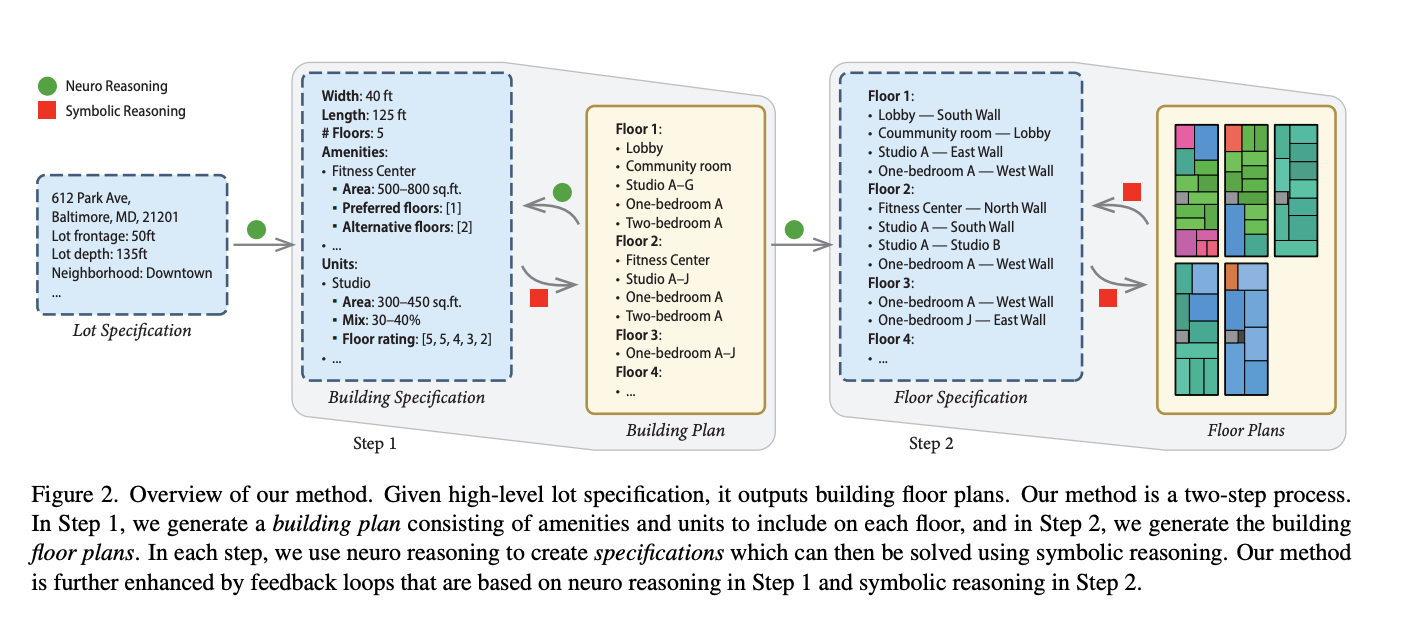
Step 1: Building Plan Generation GPT-4 generates a "building specification" that includes:
Number of floors, building width and length
Amenity specifications (type, area range, preferred floors)
Unit specifications (type, percentage range, area range, floor likelihood scores)
The system then uses Gurobi (a mixed integer linear programming solver) to determine unit quantities and floor assignments while optimizing for amenities being on preferred floors and units being on high-likelihood floors.
Step 2: Floor Plan Generation
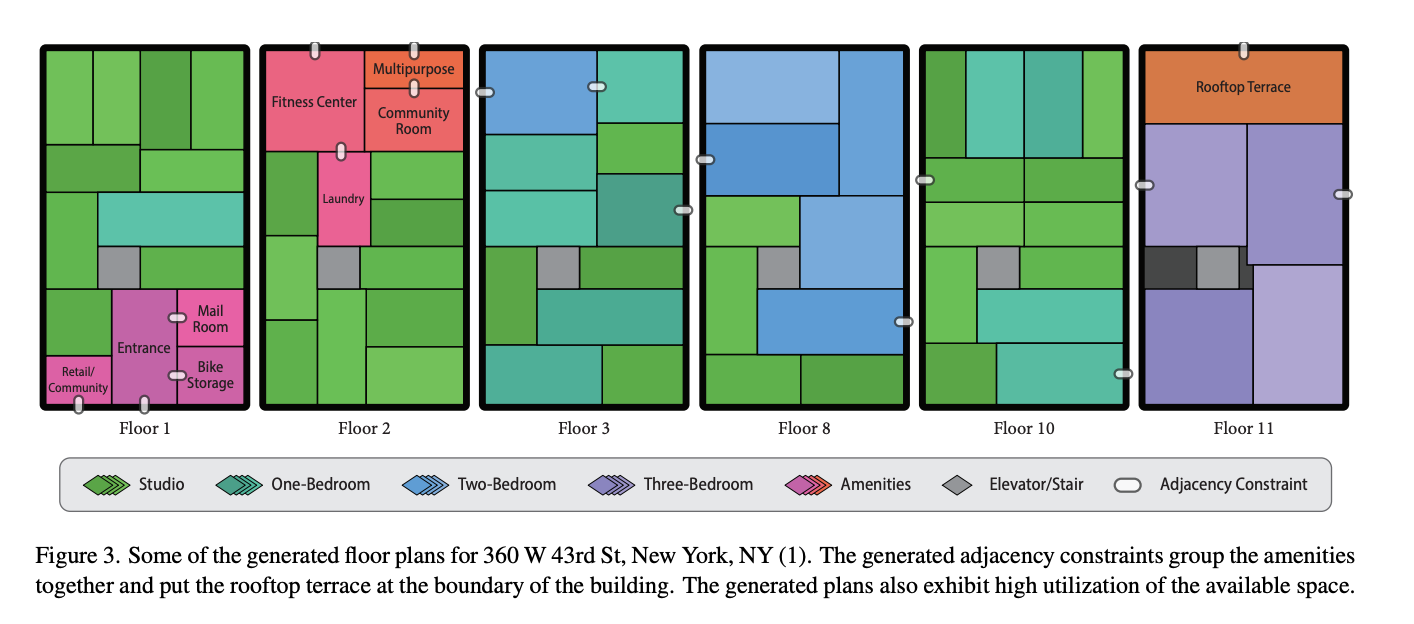
GPT-4 creates "floor specifications" containing adjacency constraints for each floor, describing which elements should be adjacent and which should be on building boundaries. Gurobi then models each element as an axis-aligned rectangle, solving for positions and dimensions while ensuring no overlaps and maximizing space utilization.
Feedback Loops for Integration
The system incorporates two types of feedback loops:
Neural Feedback Loop (Step 1): GPT-4 reviews the generated building plan and can suggest modifications to amenity specifications, such as adjusting sizes or floor preferences, removing amenities, or proposing new ones.
Symbolic Feedback Loop (Step 2): When floor plan generation fails due to conflicting constraints, Gurobi outputs an "irreducible inconsistent subsystem" - the smallest set of conflicting constraints. GPT-4 then removes one constraint from this set to resolve the conflict.
Experimental Results and Validation
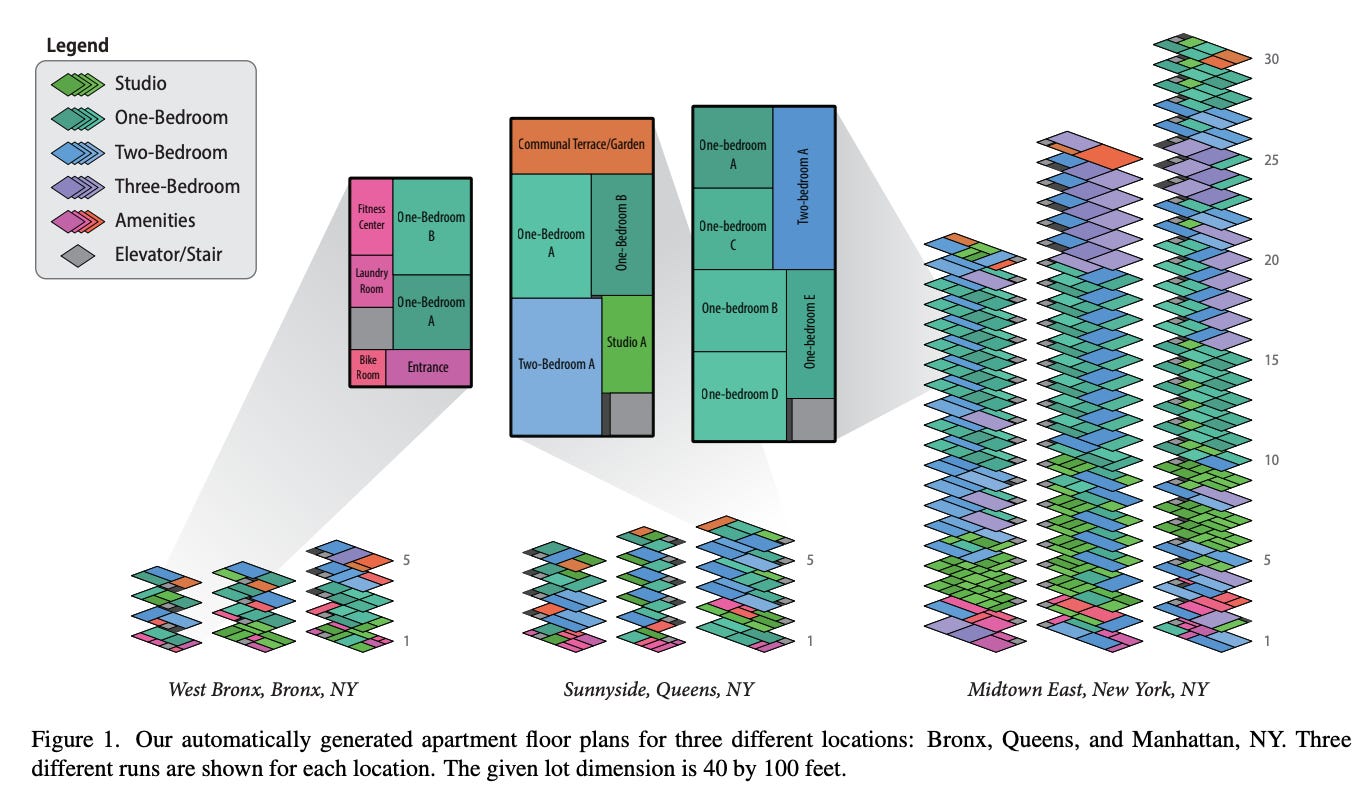
Case Study 1: New York City Neighborhoods Testing on identical 40x100 foot lots in three NYC locations produced notably different results:
West Bronx: 4-5 floor buildings with basic amenities
Sunnyside, Queens: 5-6 floor buildings
Midtown Manhattan: 20-30 floor buildings with premium amenities
These variations matched zoning regulations (R5-R7 in Bronx/Queens vs R10 in Manhattan). Unit mixes in Manhattan closely matched census data, while Bronx and Queens showed higher prevalence of studios and one-bedrooms with fewer three-bedrooms.
Case Study 2: Comparison with Real Buildings The researchers compared generated buildings against five actual apartments in Baltimore MD, Seattle WA, Chicago IL, Los Angeles CA, and New York NY. In most cases, the number of floors closely matched real buildings. The system typically included more amenities than actual buildings, but most real building amenities appeared in the generated versions.
Notably, GPT-4 made location-specific decisions like including co-working spaces in Baltimore and Seattle buildings and pet facilities in Seattle buildings, citing that "Capitol Hill neighborhood is pet-friendly."
Technical Performance
The floor plan solver achieved 98.2% average space utilization. Out of 24 total runs across both case studies, 13 had infeasible initial adjacency constraints, and the symbolic feedback loop successfully corrected 10 of these without complete regeneration.
GPT-4 correctly specified building entrance locations (as per input requirements) in 17 out of 24 runs. The system frequently grouped amenities together through adjacency constraints, creating "cliques" of amenities like package room, bike storage, community room, and lobby.
Ablation Studies: Validating the Approach
Ablation 1: Single-Step GPT-4 Only When researchers tested asking GPT-4 to generate complete floor plans in one step, it produced reasonable floor counts and could perform basic area calculations. However, it struggled with comprehensive spatial constraint enforcement and often generated incomplete solutions.
Ablation 2: Multi-Step GPT-4 Without Solvers Breaking the problem into steps but relying only on GPT-4 for validation showed improved space utilization and unit selection compared to single-step generation. However, GPT-4's self-validation had significant errors, such as incorrect arithmetic comparisons and incomplete validation of larger-scale problems.
Ablation 3: Neural Feedback Loop Analysis The neural feedback loop primarily adjusted amenity sizes to match building scale. In large Manhattan buildings, GPT-4 suggested enlarging community spaces, while in smaller buildings, it recommended downsizing. The system also suggested combining amenities (like community room and co-working space) for better space efficiency and removing laundry rooms in favor of in-unit washers and dryers.
Ablation 4: Symbolic Feedback Loop Analysis The symbolic feedback loop successfully identified and resolved constraint conflicts in 10 out of 13 infeasible cases, preserving GPT-4's original intentions while enabling successful generation.
Current Limitations
The researchers acknowledge several limitations:
Architectural Considerations: The system doesn't account for many real-world building requirements like bathroom alignment across floors for plumbing efficiency, non-rectangular building shapes, or detailed structural considerations.
GPT-4 Knowledge Limitations: While GPT-4 has general neighborhood knowledge, it lacks specific local information crucial for accurate building attribute determination.
Interface Challenges: GPT-4 occasionally breaks the JSON interface format or suggests modifications outside the allowed parameters.
Geometric Constraints: The current implementation is limited to rectangular lots and buildings, though this constraint was necessary for the mathematical formulation used.
Applications for AEC Professionals
The research demonstrates potential applications in early-stage design processes where quick generation of contextually appropriate building schemes could support decision-making. The system's ability to produce variations based on neighborhood context could be valuable for feasibility studies and initial design exploration.
The sequential neuro-symbolic approach could potentially be extended to other AEC applications where creative human insight needs to work alongside mathematical optimization, though specific implementation would require adaptation to different problem domains.
The researchers suggest future work could integrate more sophisticated floor plan generation tools, incorporate real-time local market data, add vision feedback loops for generated floor plans, and enable more complex geometric constraints.
This blog post is based on research by Milin Kodnongbua, Lawrence H. Curtis, and Adriana Schulz from the University of Washington, published in their paper "Zero-shot Sequential Neuro-symbolic Reasoning for Automatically Generating Architecture Schematic Designs."