
How Noise-Control Tech Will Transform Smart Homes by Dr. Yoav Vered
Discover how digital twins and active noise control are reshaping smart homes and what business builders can learn from Zen Acoustics’ hardware journey.

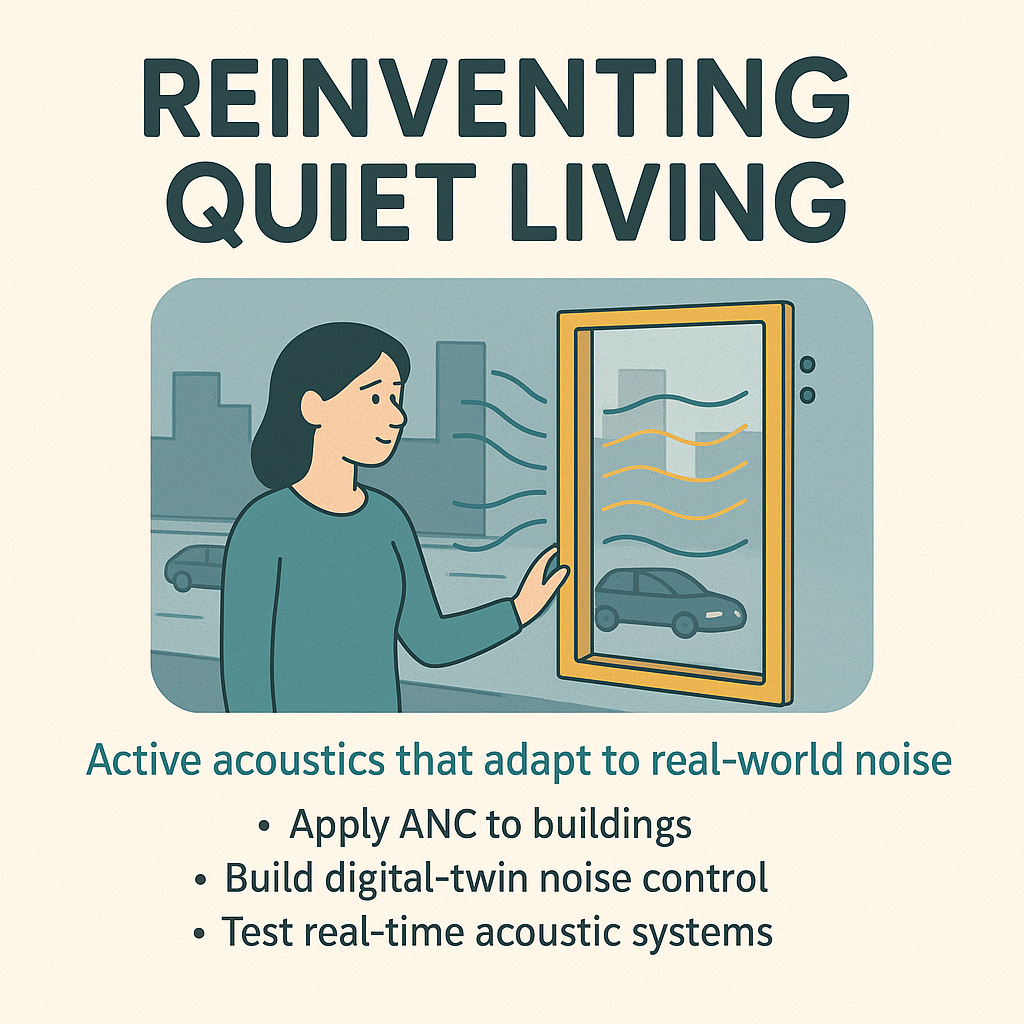
How Noise-Control Tech Is Quietly Transforming Smart Homes
For most people, noise is just an annoyance. For founders, engineers, and anyone building in the future-of-living space, it’s a massive unsolved problem hiding in plain sight.
It’s also the kind of problem that becomes obvious only when someone opens a new apartment window and gets hit by a “wall of noise” from a highway exactly what happened to Zen Acoustics’ co-founder, Pniel Rosenthal. His simple question to Dr. Yoav Vered “Can’t we just use the same noise-cancelling principles from headphones for buildings?” launched an entire company.
This blog breaks down the technology behind that journey AND what business owners can extract from it.
1. The Unexpected Origin Story: Underwater Acoustics → Building Technology
Before Zen Acoustics, Yoav was deep in academia, studying underwater acoustics at the Technion. Not construction noise. Not windows. Not buildings.
But acoustics is universal: pressure, vibration, phase, wave propagation they all obey the same physics whether you’re underwater or in a high-rise bedroom.
He then moved to the Institute of Sound and Vibration Research in the UK, where he explored two big ideas:
Digital twins for real-time control systems
Active noise control (the same core idea behind noise-cancelling headphones)
This cross-domain background became Zen Acoustics’ secret weapon. It’s a reminder to founders:
Your breakthrough might not come from your industry
it might come from a discipline no one else is borrowing from yet.
2. What Digital Twins Actually Bring to Noise Control
Most people think a digital twin is a fancy BIM model. Yoav frames it differently:
A digital twin is a living, constantly updating virtual version of a real system.
Not a one-off simulation.
Not a static rendering.
A real-time engine that you can control and learn from.
This matters because buildings only give you a few points to measure:
A couple of microphones
Maybe an accelerometer
A handful of sensors
But the acoustic field has thousands of data points you can’t measure directly.
A digital twin helps fill in that missing information like having night-vision goggles for the invisible parts of a room’s sound environment.
For business owners, the principle is powerful:
When you can’t measure everything, model the parts you can’t see.
That’s how you compete when resources (and data) are limited.
3. Borrowing Proven Tech: Headphones and Electric Cars
Yoav’s previous work explored:
How headphones improve ANC depending on direction of incoming noise
How electric cars use ANC to reduce road and tire noise (now noticeable because engines are quiet)
This is where the opportunity clicked:
If ANC can predict and cancel sound inside a car or headphone cup, then a similar form of anti-noise could theoretically be generated at a building opening.
It’s not easy, windows aren’t sealed environments but the physics doesn’t change:
Noise + anti-noise (in opposite phase) = reduced sound.
Some of the most successful startups win by applying a proven idea in a new domain. That’s exactly what happened here.
4. Building the First Prototype: Less Glamorous Than It Sounds
The Zen Acoustics lab isn’t a Silicon Valley showroom.
It’s a 100-year-old British safe room in Haifa, connected to an anechoic chamber that simulates outdoor noise.
The setup includes:
Microphones and accelerometers
Speaker arrays
Real-time hardware (FPGA-based control)
A window-like opening to test real spatial acoustics
Every day, Yoav describes working through puzzles like:
How to run real-time noise cancellation without delay
How to fit algorithms on limited FPGA resources
How to make lab behavior match real-world noise
How to design sensing that reacts to trucks, motorcycles, and cars all different sound signatures
For anyone building hardware:
Real-time systems are unforgiving.
Hardware is slow to iterate.
And “working in theory” is not the same as “working in a noisy street.”
5. What This Tech Could Look Like in Real Homes
Yoav emphasizes that Zen Acoustics isn’t selling one product. They’re building a platform that can integrate into different solutions.
Option 1: Integrated Window Systems
For new buildings and developers:
Sensors embedded in the aluminum frame
Micro-speakers built into the window
A small controller acting like a modem
Works when the window is opened slightly
Option 2: Retrofit Kits for Existing Homes
For people already dealing with noise:
A compact add-on box
An external sensor
Thin speaker bars
Easy install, no renovation needed
This is the moment every founder eventually hits:
Your biggest market isn’t always your first adopter.
Your first adopter is simply the person in the most pain.
Zen initially thought window companies would be the starting point.
Turns out, desperate homeowners suffering from noise might lead adoption.
Market reality beats assumptions.
6. Lessons Every Business Owner Can Use
1. Explore use cases before committing to one
The “obvious market” might not be your entry point.
2. Invest equally in tech R&D and business R&D
Talking to customers is part of building the product.
3. Build for adaptability, not perfection
Early architecture matters more than early aesthetics.
4. Deep expertise compounds even across industries
Yoav’s underwater acoustics research became building-tech innovation.
5. Real-world environments reveal the truth
Noise cancellation inside a lab is controlled.
Noise cancellation outside is where businesses win or die.
6. Aim for products people don’t remember living without
Yoav put it simply:
“Once people can control acoustic environments at home, they’ll forget how it was before.”
That’s the hallmark of a category-creating technology.
Closing Thought
The next decade of smart homes isn’t just about thermostats, sensors, or energy dashboards. It’s about comfort air quality, lighting, personalized zones, and yes, noise.
Zen Acoustics is showing how deep science, when applied creatively, becomes a consumer-facing innovation that feels like magic.
Whether you’re a founder, a builder, or an operator, the message is clear:
Don’t look for “new ideas.” Look for proven ideas in the wrong industry.
That’s where the real breakthroughs hide.
If this journey speaks to you, you’ll get even more from the complete episode.
🎧 Listen here for more episodes: