
From Elevators to AI: Startup Lessons from Bridgeline by Dan Shaw
Learn how Dan Shaw built Bridgeline by turning real construction pain points into an AI-powered business and what founders can learn from his journey.

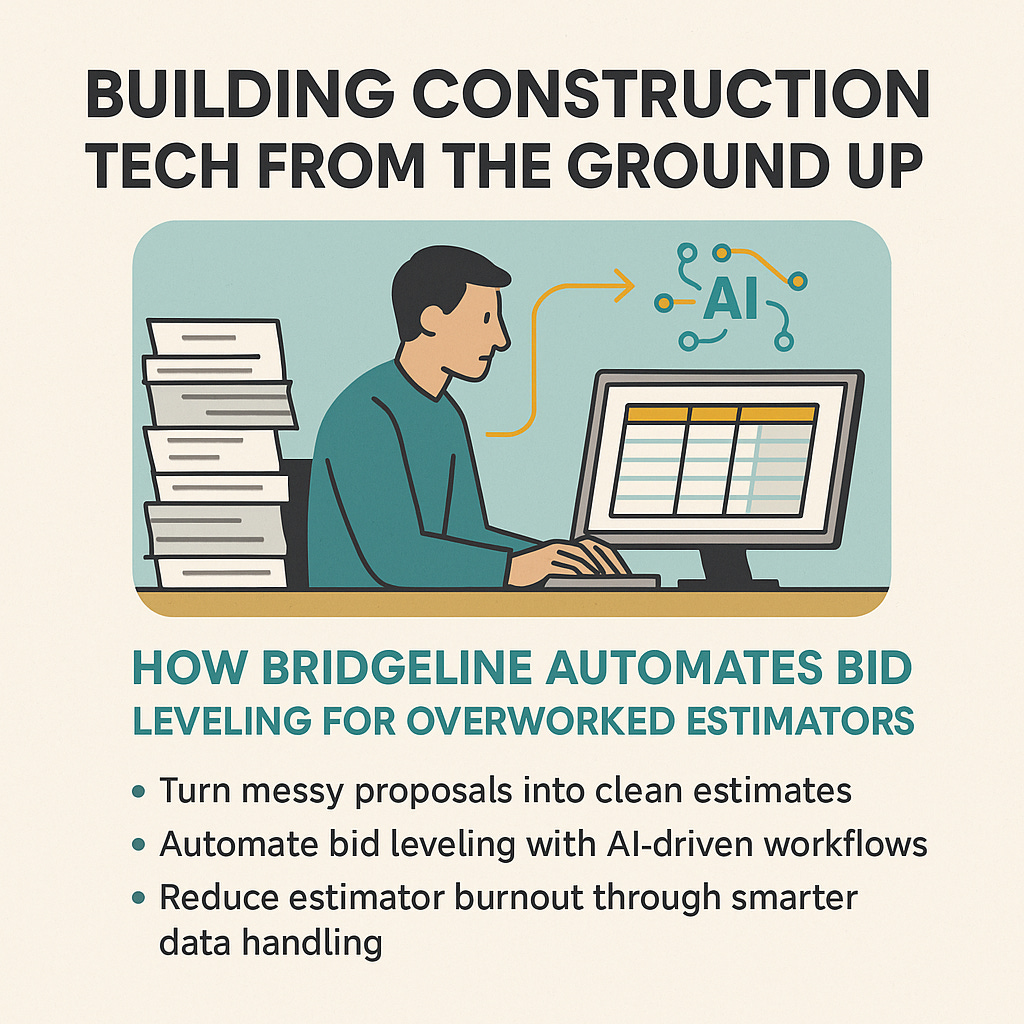
From Elevators to AI: Lessons on Building Real Businesses from the Ground Up
When Dan Shaw, co-founder and CEO of Bridgeline, talks about startups, he doesn’t sound like your typical tech founder.
He sounds like someone who’s been in the trenches someone who knows that building anything real means balancing chaos, deadlines, and constant learning.
Before creating an AI platform for pre-construction workflows, Dan spent nearly a decade selling elevators. It’s an unexpected path into tech but it shaped how he thinks about customers, precision, and the patience required to ship great products.
Bridgeline’s journey is full of lessons for anyone trying to grow or scale a business whether you run a SaaS, service company, or creative agency.
1. The Hardest Yard: Why Finishing Beats Starting
When Bridgeline was preparing its first product release, Dan described it as “getting things to the one-yard line.”
Everything was close but not quite done. The team had a trade show deadline, incomplete features, and a ton of uncertainty. Still, they launched.
That moment taught a core lesson: perfection is a moving target.
In Dan’s words, “You can get things to the one-yard line, but getting them across the finish is the hardest part.”
For business owners, this is crucial:
Launch before you’re ready. Feedback beats speculation.
Momentum compounds. Progress builds clarity faster than planning.
Finishing is a mindset. The best operators know when to stop polishing and start shipping.
Execution isn’t glamorous, but it’s where every business earns credibility.
2. Turning Frustration into Innovation
Bridgeline didn’t start with a fancy idea. It started with frustration.
When Dan worked in elevator sales, general contractors constantly asked technical questions that required engineering input. Each answer took a week and by then, the deal’s energy was gone.
That bottleneck sparked a question:
“If all this technical knowledge already exists, why can’t we access it instantly?”
That thought evolved into Bridgeline, an AI-powered platform that automates the bid-leveling process comparing subcontractor bids across formats (PDF, Excel, Word, even handwritten notes) to flag discrepancies and highlight missing scopes.
For founders, the principle here is simple:
Real innovation doesn’t come from brainstorming sessions it comes from daily friction you refuse to ignore.
If you’ve felt that same “there has to be a better way” moment in your workflow that’s your opportunity space.
3. Selling Change, Not Just Software
Selling AI software to construction professionals isn’t like selling a CRM or a SaaS dashboard.
As Dan explains, selling elevators was straightforward everyone knew they needed one. But selling AI for estimating meant convincing people that change itself was worth the effort.
That humility shaped Bridgeline’s early sales motion. They didn’t frame it as disruption; they framed it as assistance.
Instead of saying, “This will replace your process,” they said, “This will make your process faster.”
This is a playbook any business owner can use:
Respect the legacy process first.
Show how your solution fits into existing rhythms.
Help customers feel safe adopting something new.
The more complex your market, the more empathy matters.
4. The Year of “No”: Discovery Over Assumption
When Bridgeline’s first prototype launched, the response was humbling.
“No one wanted to buy it,” Dan admits. “But everyone wanted to talk to us.”
That year turned into a masterclass in customer discovery. They stopped trying to sell and started asking better questions. What’s slowing you down? What would actually make your week easier?
Those conversations revealed what the market really wanted and forced a complete repositioning.
Dan sums it up perfectly:
“We went from a solution looking for a problem to a problem that needed a solution.”
That shift from pushing a product to solving a pain saved them time, energy, and credibility.
For founders, it’s a reminder: rejection is often the most honest feedback you’ll get.
5. The Detail Mindset: Where Trust Lives
One of Dan’s early mentors taught him, “The devil’s in the detail.”
That stuck.
In construction, details aren’t small they’re everything. A single missed line item in a bid can create millions in risk. Estimators, Bridgeline’s core users, are wired to spot precision errors instantly.
That’s why Bridgeline’s AI focuses not just on automation, but accuracy.
For any business, this mindset applies:
Customers notice precision.
Reliability scales faster than hype.
Details communicate respect.
Vision matters, but execution builds trust and trust compounds.
6. Finding the Real Customer
Bridgeline’s turning point came when they identified their ideal customer profile (ICP):
Construction firms with ≤5 estimators
Bidding 5+ jobs per month
Leadership hesitant to hire more staff due to non-billable hours
These companies felt the pain hardest overworked teams, paper-heavy processes, and high burnout risk.
That focus unlocked product-market fit.
Instead of chasing enterprise logos, Bridgeline served the mid-market customers who needed them most.
Lesson for entrepreneurs: clarity beats size. The right niche creates speed, profitability, and word-of-mouth growth.
7. Cold Calling Still Works, If You Do It Right
Despite building an AI company, Dan still cold calls.
He says it’s both a validation tool and a feedback loop.
“The goal isn’t to close the sale,” he explains. “It’s to keep them on the phone ten more seconds long enough to get curious.”
This approach reframes outreach:
Measure curiosity, not conversion.
Track conversations, not clicks.
Treat objections as insights, not rejections.
In an era obsessed with automation, genuine human curiosity still wins attention and attention drives opportunity.
8. Borrow Playbooks, Don’t Copy Them
Dan admires founders like Dustin DeVan of BuildingConnected and the team behind Togal.AI, but he doesn’t imitate them.
He studies how they think, not what they build.
“You can’t copy success; you can only interpret it,” he says.
For founders, this is an antidote to comparison syndrome.
Your timing, audience, and resources are different your strategy should be too.
Borrow frameworks, not formulas.
9. Scaling Relationships, Not Just Software
Construction is notoriously relationship-driven and Dan embraces that.
Bridgeline’s next growth step is extending value downstream to subcontractors and upstream to owners and architects, creating a workflow network where everyone benefits.
That’s how software builds defensibility not through features alone, but through ecosystems of trust.
Whatever industry you’re in, your “ecosystem strategy” is what transforms a product into infrastructure.
10. The Founder’s Final Lesson
Dan closes with a simple line:
“If you think of something, go out there and do it. You’ll never kick yourself for trying or betting on yourself.”
It’s not motivational fluff it’s lived experience.
Bridgeline wasn’t born from perfect timing or a viral launch. It was built through persistence, humility, and the willingness to learn fast from friction.
That’s what makes it a case study in real entrepreneurship not overnight success, but earned clarity.
Key Lessons for Business Owners
Finish what you start. Momentum matters more than perfection.
Solve what frustrates you. Pain is your best product roadmap.
Respect existing systems. Change feels safer when it fits.
Treat “no” as data. Every rejection is a compass.
Precision builds trust. Details make your product believable.
Sell through curiosity. Conversations > clicks.
Build around relationships. Ecosystems are the new moats.
If this journey speaks to you, you’ll get even more from the complete episode.
🎧 Listen here for more episodes: