
Autonomous BIM Modeling with AI Agents
A practical look at BIMgent, a GUI-based AI agent that automates BIM authoring by using design software like a human, step by step.

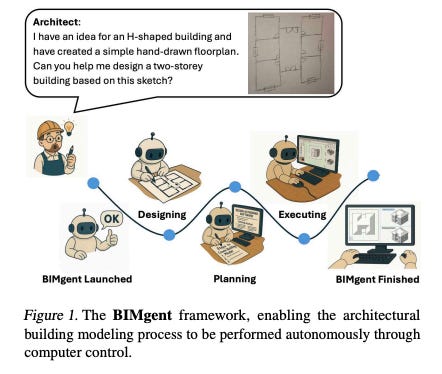
When AI Starts Using BIM Like a Human
Most conversations about AI in BIM focus on assistance around the edges checking models, extracting quantities, flagging issues, or generating scripts.
What they rarely address is the most time-consuming part of BIM work itself: manual authoring inside complex design software.
The research behind BIMgent explores a different approach. Instead of integrating AI through APIs or custom plugins, it asks a simpler but harder question:
Can an AI agent operate BIM software through the graphical interface in the same way a human does?
The paper does not claim this solves design automation. What it demonstrates is something more specific: autonomous execution of BIM authoring workflows via GUI interaction.
What BIMgent Actually Does
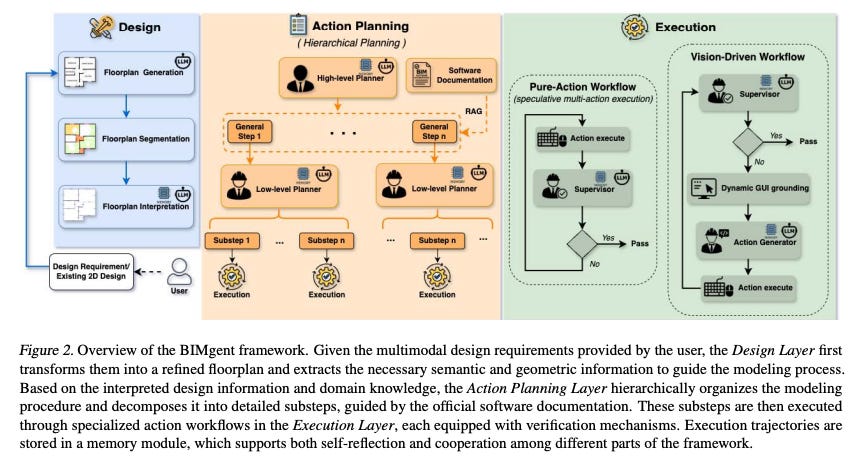
BIMgent is an agentic framework that:
Takes design intent as text descriptions, sketches, or existing floorplans
Converts that intent into a structured plan
Executes BIM modeling steps by controlling the software GUI directly
This includes:
Creating design layers
Placing walls, slabs, openings, and roofs
Editing parameters through dialogs
Verifying results after each step
All interactions happen through mouse and keyboard actions, not internal APIs.
Why GUI Control Matters in BIM
BIM authoring tools expose:
Highly parameterized commands
Multiple interaction modes
Dense, visually noisy interfaces
These characteristics make traditional automation brittle. BIMgent addresses this by treating BIM software as a visual, interactive environment, not a programmable backend.
That choice defines most of the system’s technical design.
The Core Technical Ideas (Without the Jargon)
1. Modeling Is a Long, Interdependent Process
The paper highlights that a single modeling task often involves 100+ sequential actions. One incorrect step can cascade into failure.
To manage this, BIMgent uses:
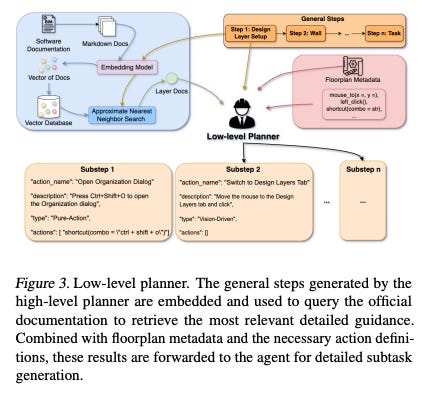
A high-level planner to define modeling phases (layers → walls → slabs → openings → roof)
A low-level planner to generate concrete actions for each phase
This mirrors how architects typically approach modeling, rather than attempting to generate one monolithic action sequence.
2. Software Knowledge Is Retrieved, Not Hardcoded
Instead of embedding fixed instructions, BIMgent:
Retrieves relevant sections from official software documentation
Uses that information to decide how to execute each action
This allows the agent to adapt its behavior to the tool’s intended usage patterns, rather than relying on brittle assumptions.
The paper evaluates this approach only within Vectorworks, but the mechanism itself is software-agnostic in design.
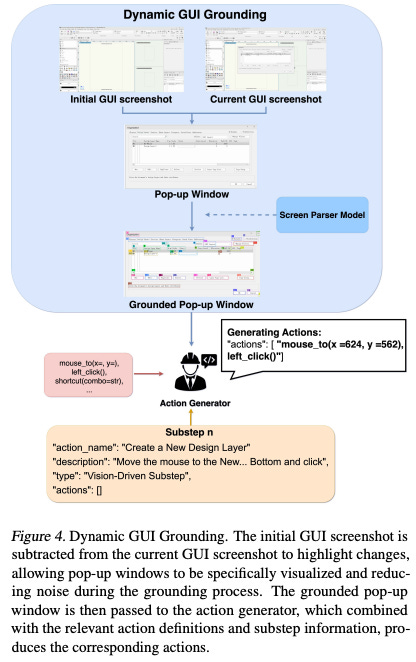
3. Visual Attention Is Narrowed Deliberately
BIM interfaces contain many static elements that are irrelevant to a specific task. BIMgent introduces a dynamic GUI grounding strategy:
It compares screenshots to detect what changed
Focuses interaction on those regions (often pop-up dialogs)
Ignores the rest of the interface
This significantly reduces visual noise during parameter editing and tool configuration.
4. Every Action Is Checked
After each action, a supervisor component verifies whether:
The intended element was created
Parameters were applied correctly
The software state matches expectations
If not, the agent revises or regenerates actions before proceeding.
The ablation study shows this supervision and reflection are essential to achieving non-zero end-to-end success.
What the Evaluation Shows (and What It Doesn’t)
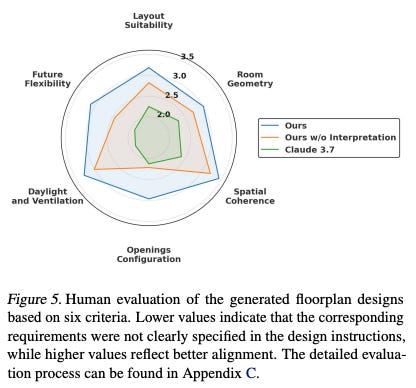
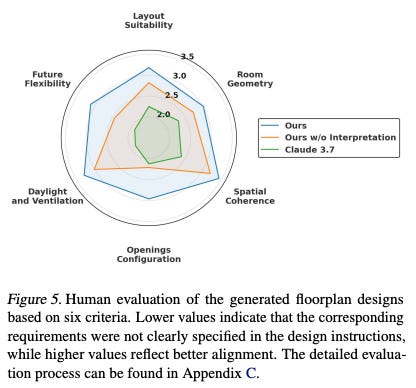
The authors introduce a Mini Building Benchmark with 25 real modeling tasks executed inside Vectorworks.
Key results:
32% end-to-end task success
86–95% success for repetitive components like walls and openings
Baseline GUI agents failed to complete any full task
These numbers should be read carefully. The tasks are long, open-ended, and fragile. Achieving partial success across many steps is already non-trivial.
The system performs best where:
Geometry is repetitive
Parameters are well-defined
Floorplan metadata is available
It struggles more with:
Complex parameter dialogs
Planning errors
Visual grounding mistakes
Practical Meaning for AEC Workflows
BIMgent does not automate architectural design.
What it shows is that labor-intensive BIM authoring steps can be executed autonomously under supervision.
This has implications for:
Early-stage model drafting from sketches or briefs
Rebuilding models from legacy drawings
Rapid iteration during feasibility studies
Automating repetitive setup and configuration tasks
Rather than replacing designers, this kind of system targets manual modeling effort, not design judgment.
The Larger Signal
The most important contribution of BIMgent is not its performance metrics.
It is the demonstration that computer-use agents can function inside professional BIM software, despite its complexity.
This opens a different research and product direction than API-centric automation:
Agents that see the screen
Plan over long workflows
Execute actions
Verify results
Recover from failure
For AEC, where tools are visual, stateful, and workflow-heavy, this direction is particularly relevant.
Closing Thought
BIMgent does not claim to solve BIM automation.
It demonstrates, with evidence, that:
Autonomous agents can already handle meaningful portions of BIM authoring by interacting with the software exactly as humans do.
That alone is a significant step and a foundation future systems can build on carefully, not hypothetically.
This blog post is based on research by Zihan Deng, Changyu Du, Stavros Nousias, and André Borrmann, published in the paper “BIMgent: Towards Autonomous Building Modeling via Computer-use Agents.”