
How AI Understands Client Experience in Design
Explore how AI integrates human experience data into design workflows to improve decision-making and create more client-aligned spaces.

The Core Problem: Translating Client Experience into Design
In interior design and broadly across AEC there’s a persistent gap:
Clients experience spaces emotionally
Designers work with structured inputs
That mismatch creates friction.
The paper AIDED focuses on this exact issue:
How can client experience be captured and used effectively in AI-assisted design workflows?
What the System Actually Does
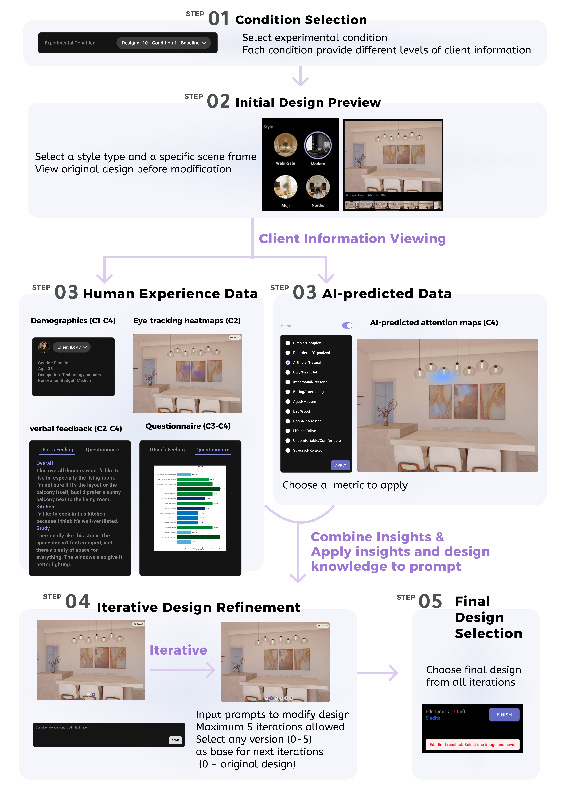
The researchers built a system called AIDED, designed to integrate client experience data into generative AI workflows.
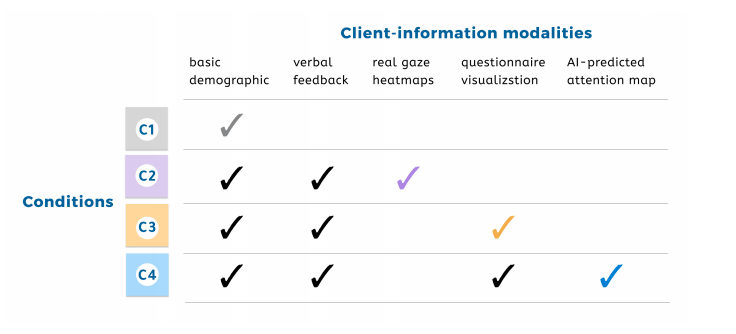
Instead of relying only on traditional briefs, the system introduces four types of client information:
1. Demographic Briefs (Baseline)
Age, occupation, budget, lifestyle
Represents typical early-stage inputs
👉 This serves as the control condition
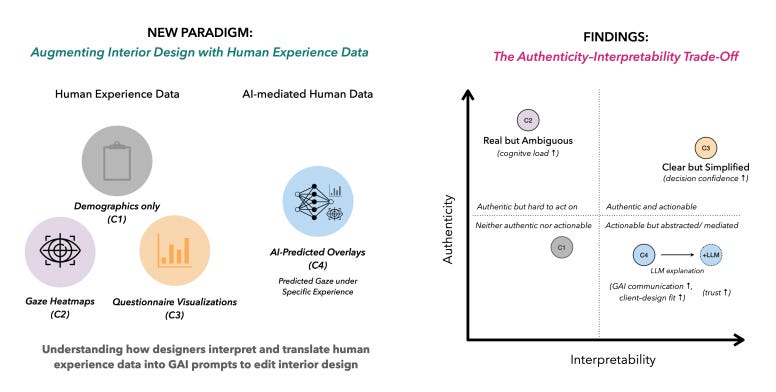
2. Gaze Heatmaps
Tracks where users look in interior scenes
Visualized as attention maps over space
👉 Captures implicit attention, not verbalized preferences
Finding:
High authenticity
But increased cognitive load and ambiguity
3. Questionnaire Visualizations
Structured ratings across 15 Architectural Experience (AE) dimensions
e.g., comfort, naturalness, complexity
Presented as charts
👉 Converts subjective experience into structured data
Finding:
Most trusted and actionable format
Improved satisfaction and creativity
4. AI-Predicted Attention Overlays
AI predicts which spatial regions matter based on questionnaire data
Generated using a multimodal model + Grad-CAM
👉 Acts as a mediated interpretation layer
Finding:
Improved communication with AI
Required natural language explanations to build trust
The Study Setup (Why This Matters)
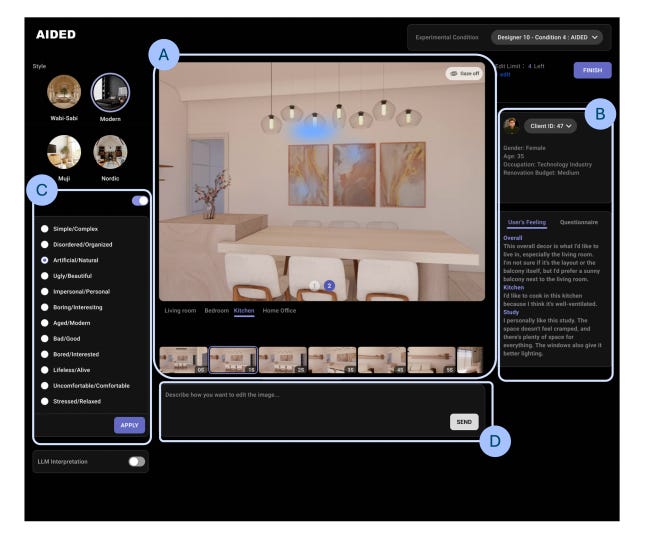
This isn’t a conceptual framework, it was tested.
12 professional designers
4 conditions (C1–C4) using different data types
Each designer:
iteratively modified designs
evaluated trust, effort, and satisfaction
👉 This gives weight to the findings, it’s based on actual workflow behavior
The Most Important Insight
The Authenticity–Interpretability Trade-Off
The paper identifies a core tension:
Authentic data (like gaze)
rich, close to real experience
harder to interpret
Structured data (like questionnaires)
easier to use
less nuanced
This trade-off directly affects:
cognitive effort
trust
design decisions
What Designers Actually Did Differently
1. Structured data led to better decisions
Designers:
trusted it more
used it more confidently
produced more satisfying outcomes
👉 Because it was clear and actionable
2. Raw experiential data wasn’t enough
Even though gaze data reflects real behavior:
designers struggled to translate it into design actions
👉 Insight:
More data doesn’t automatically improve design, it needs interpretation
3. AI’s role shifts from generator to mediator
A key contribution of the system:
AI doesn’t just generate images
It helps translate client signals into design-relevant insights
This becomes especially clear when:
overlays are paired with LLM explanations
turning visual signals into actionable suggestions
What This Means for AEC Workflows
1. Client data needs structuring to be useful
Designers already rely on:
questionnaires
checklists
The study confirms why:
they reduce ambiguity
support better decisions
2. More data ≠ better outcomes
Raw signals (like gaze) can:
increase cognitive load
slow down interpretation
👉 Tools need to translate, not just collect
3. Explainability is critical for adoption
AI-generated insights alone are not enough
Designers need:
reasoning
context
👉 This directly affects trust
4. Designers remain central to decision-making
The system:
supports designers
does not replace them
Designers still:
interpret trade-offs
balance feasibility
maintain control over final decisions
Limitations Highlighted by the Study
Small sample size (12 designers)
Focused on residential interior design
AI outputs still require:
human validation
interpretation
👉 This is an early-stage exploration
Final Takeaway
The contribution of this work is not about better image generation.
It’s about something more specific:
How to make human experience usable inside AI-driven design workflows
And the key lesson is simple:
Raw human data is valuable
But only when it becomes interpretable and actionable
This blog post is based on research by Yang Chen Lin, Chen-Ying Chien, Kai-Hsin Hou, Hung-Yu Chen, and Po-Chih Kuo, published in the paper “AIDED: Augmenting Interior Design with Human Experience Data for Designer–AI Co-Design.”
If you are exploring ai in construction or need support in GTM for your construction tech startup, book a discovery call using this link :
https://calendly.com/mayur-mistry7/consultancy-discovery-call