
Scaling AI Workflow Automation in AEC Tech by Adam Banga
Discover how Nonlinear helps AEC founders automate PDF workflows with AI, cut review time from days to hours, and scale construction tech startups efficiently.

From Construction Sites to Stanford Labs, The AEC Founder’s Journey
Every startup starts with friction and for Adam Banga, that friction was rework, emails, and endless PDFs.
He began his journey at Turner Construction and XL Construction, watching field and office teams struggle with communication gaps and manual workflows. Later at Stanford, as a structural engineering grad student, he discovered how tedious submittal review could be comparing hundreds of product specs against design documents line by line.
That pain became the spark for his first product: Spec.AI, built to automate the submittal review process. It was his first step into AEC tech automation, showing that deep industry problems could be solved with AI-driven workflows instead of more spreadsheets.
Takeaway: Real pain drives real products not ideas dreamt up in isolation.
The “Why Now” Moment Building in an AI-Native Era
Timing matters more than talent.
For Adam and his co-founders, the “why now” was clear: AI models had finally become accurate enough to understand and structure the unstructured PDFs, drawings, and specs. That shift unlocked automation for processes that were once fully manual.
At the same time, construction firms faced a talent crisis. Younger engineers entering the workforce expect to use AI tools. If firms don’t modernize, they lose talent. The intersection of these two forces tech maturity and market pull created the perfect window for innovation.
Try this: Ask yourself two questions before launching any AEC SaaS product:
Why now? (What’s changed that makes this possible today?)
Why hasn’t this existed before?
If you can answer both clearly, you’re probably building at the right time.
Benefit: Build something the market is ready for not something it tolerates.
From Pitch to Product Defining Moments in Nonlinear’s Growth
Every founder remembers their first “yes.”
For Nonlinear, it came at a Georgia incubator under KP Ready’s Shadow Ventures, where a demo of their submittal automation won over their first client PAE, a leading engineering firm. That moment validated the idea and gave them confidence to scale.
The team raised $1.1M in pre-seed funding, entered Y Combinator (but ultimately chose a sector-focused VC partner), and in true startup fashion rebuilt the platform three times before launch.
The third version unified the front and backend into a single architecture, making Nonlinear scalable, fast, and intuitive for users. Same clean UI. Entirely new engine.
Lesson: It’s not the first build that matters it’s the one that survives user feedback.
Scaling Adoption in a Slow-Moving Industry
In AEC, selling software isn’t the challenge. Getting people to use it is.
Construction firms juggle dozens of tools already. Learning one more can feel like work, not progress. So the Nonlinear team took a radical approach: meet users where they already are email.
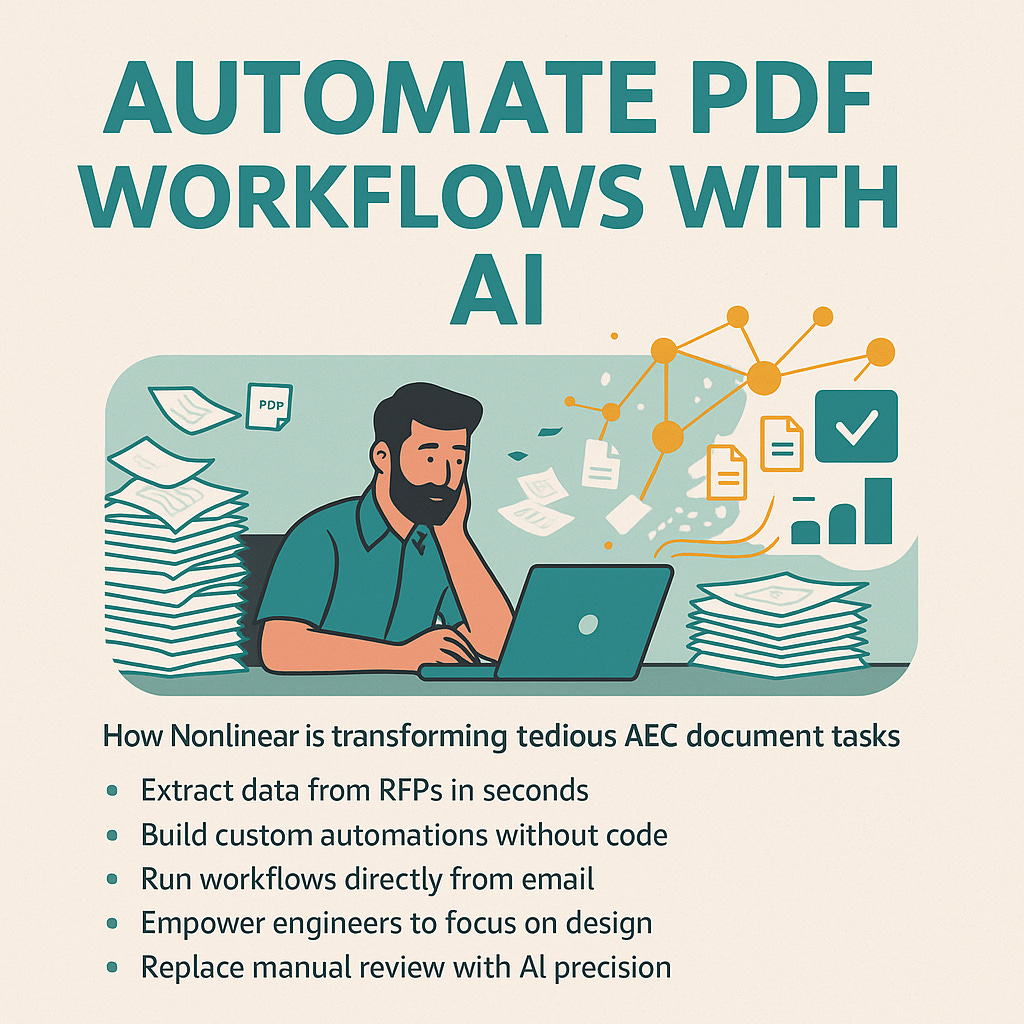
Instead of forcing users to log into yet another app, engineers can simply send a PDF to agent@nonlinear.build, and the system automatically extracts data, populates templates, and returns results within minutes.
That frictionless approach became a superpower. One workflow can now automate submittal reviews, bid leveling, and RFP parsing without changing how teams operate.
Takeaway: Adoption accelerates when your product disappears into existing habits.
Founder Lessons Grit, Feedback, and Building What Lasts
Startups are marathons disguised as sprints.
Adam shared three lessons that helped Nonlinear move from concept to product used by enterprise teams:
Detach from your first idea. You’ll pivot and that’s healthy.
Validate fast. Weekly feedback cycles beat perfect releases.
Have a goal outside work. For Adam, marathon training kept him grounded through the chaos of rebuilds and rejections.
Today, Nonlinear helps AEC founders and teams cut task times from days to hours, bringing automation into the workflows that need it most PDFs, specs, and compliance-heavy reviews.
Final Word: In the built environment, progress doesn’t come from waiting for the industry to catch up. It comes from building tools that make catching up inevitable.
If this journey speaks to you, you’ll get even more from the complete episode.
🎧 Listen here for more episodes: